


Aluminium Pivot Windows vs Sliding Windows: Which One Is Right for Your Home?
Aluminium Pivot Windows vs Sliding Windows: Which One Is Right for Your Home?
Picking windows sounds simple. Until you actually start looking.
You Google it, land on a few pages, and suddenly there are ten window types you’ve never heard of. Pivot windows. Sliding windows. Casement. Awning. What?
We deal with this every day at TwinPro Venture. So we thought, let’s just write the honest version. No confusing terms, no over-explaining. Just what you actually need to know about aluminium pivot windows vs sliding windows before you make a decision.
What Even Is a Pivot Window?
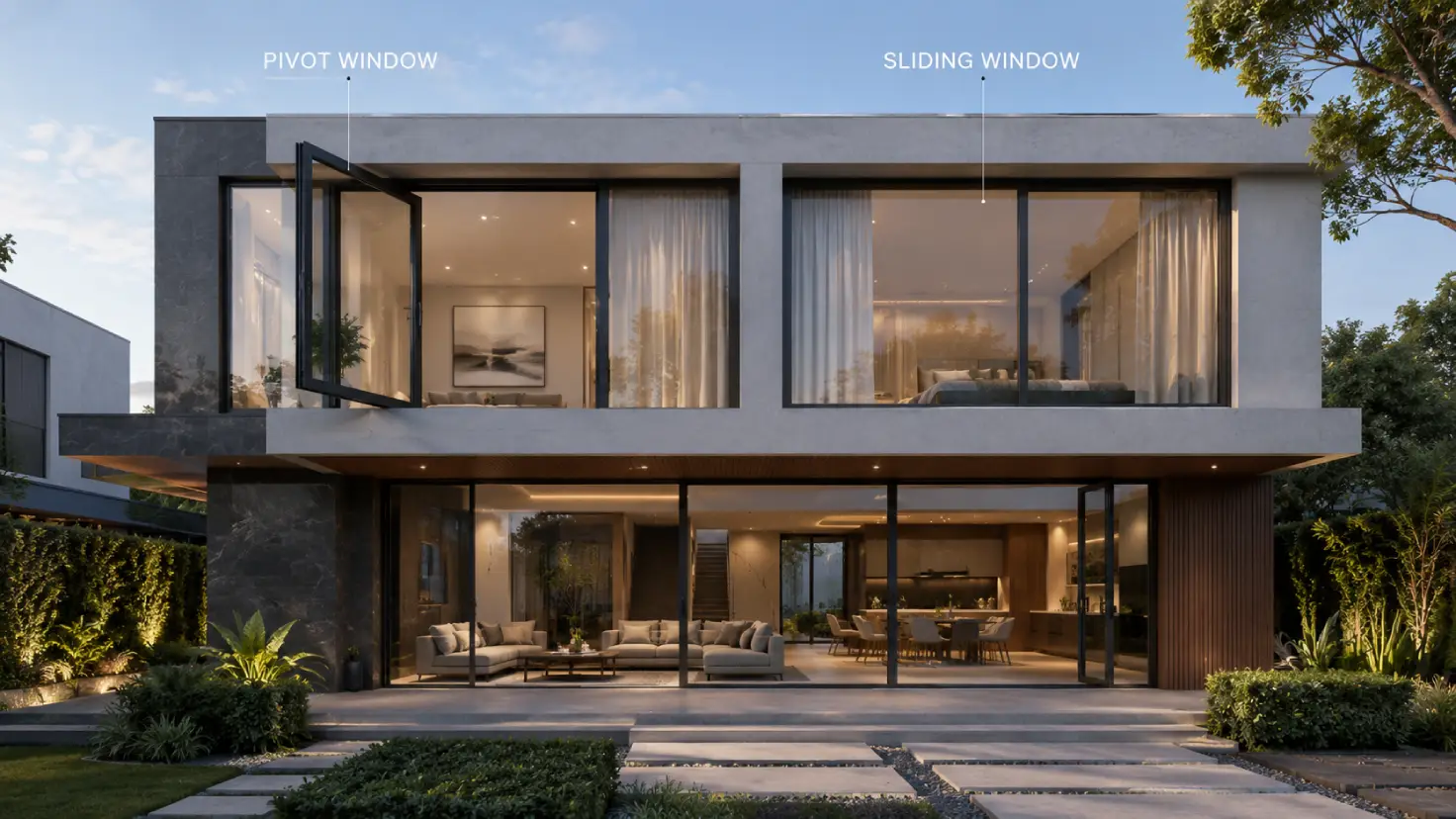
A pivot window rotates. It turns on a centre point, kind of like a revolving door, but it’s your window.
When you push it open, one side swings in and the other swings out at the same time. Some pivot windows turn left to right. Others turn top to bottom. Both work the same way, on a central axis.
They look very modern. Big glass panels, thin frames, clean lines. You’ll notice them in newer apartments, contemporary villas, and office buildings.
If you’ve seen a window that looks like it’s doing something unexpected when it opens, that’s probably a pivot window.
What About Sliding Windows?
You already know this one.
One panel sits fixed. The other slides along a track. That’s it. Pull it open, push it closed.
Sliding windows have been the standard in Indian homes for a long time, especially in apartments. They’re simple, they don’t take up extra space, and almost everyone knows how to use them without thinking- Aluminium Pivot Windows vs Sliding Windows
How They Open, and Why It Matters – Aluminium Pivot Windows vs Sliding Windows
This is the biggest practical difference between the two.
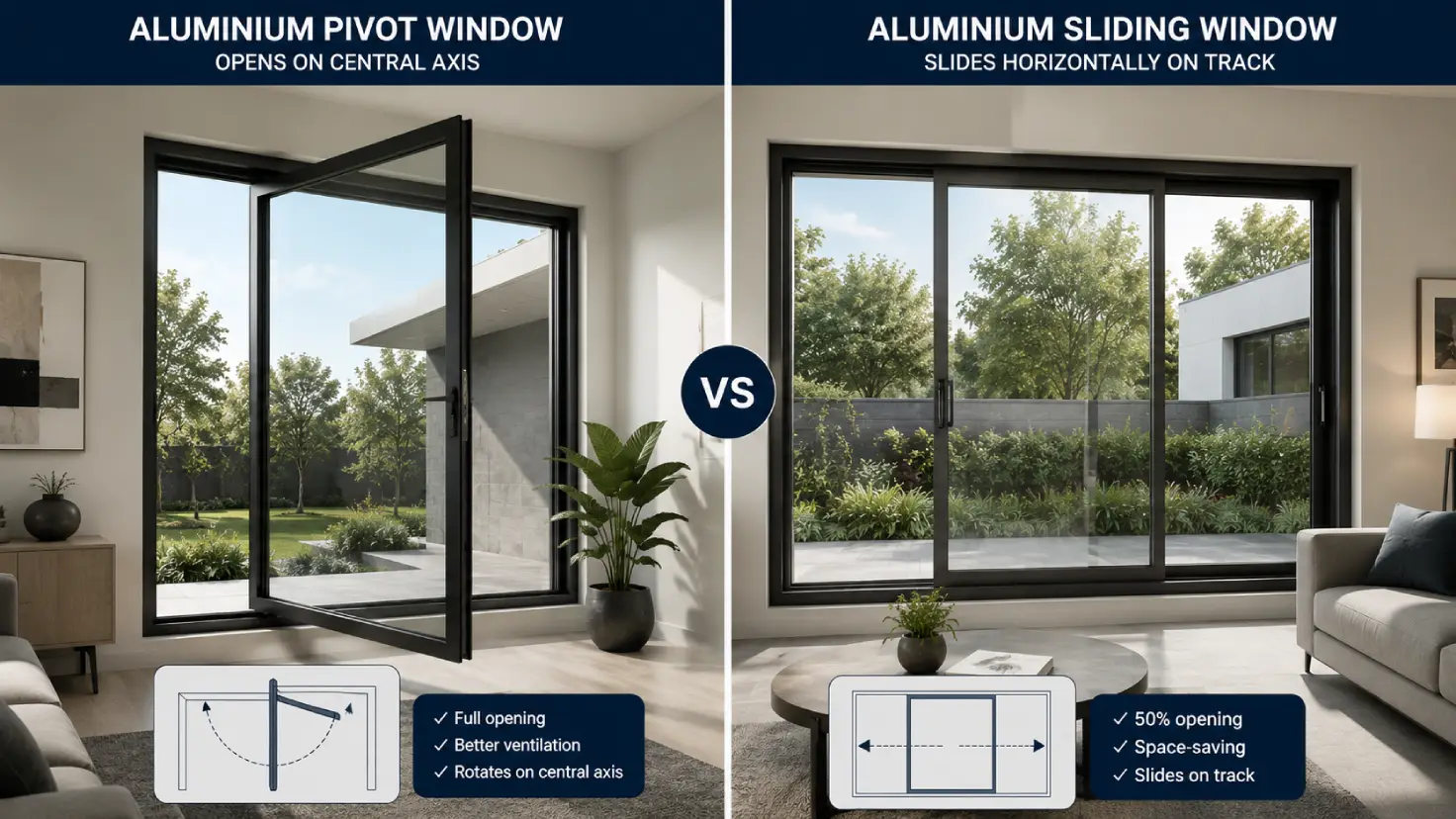
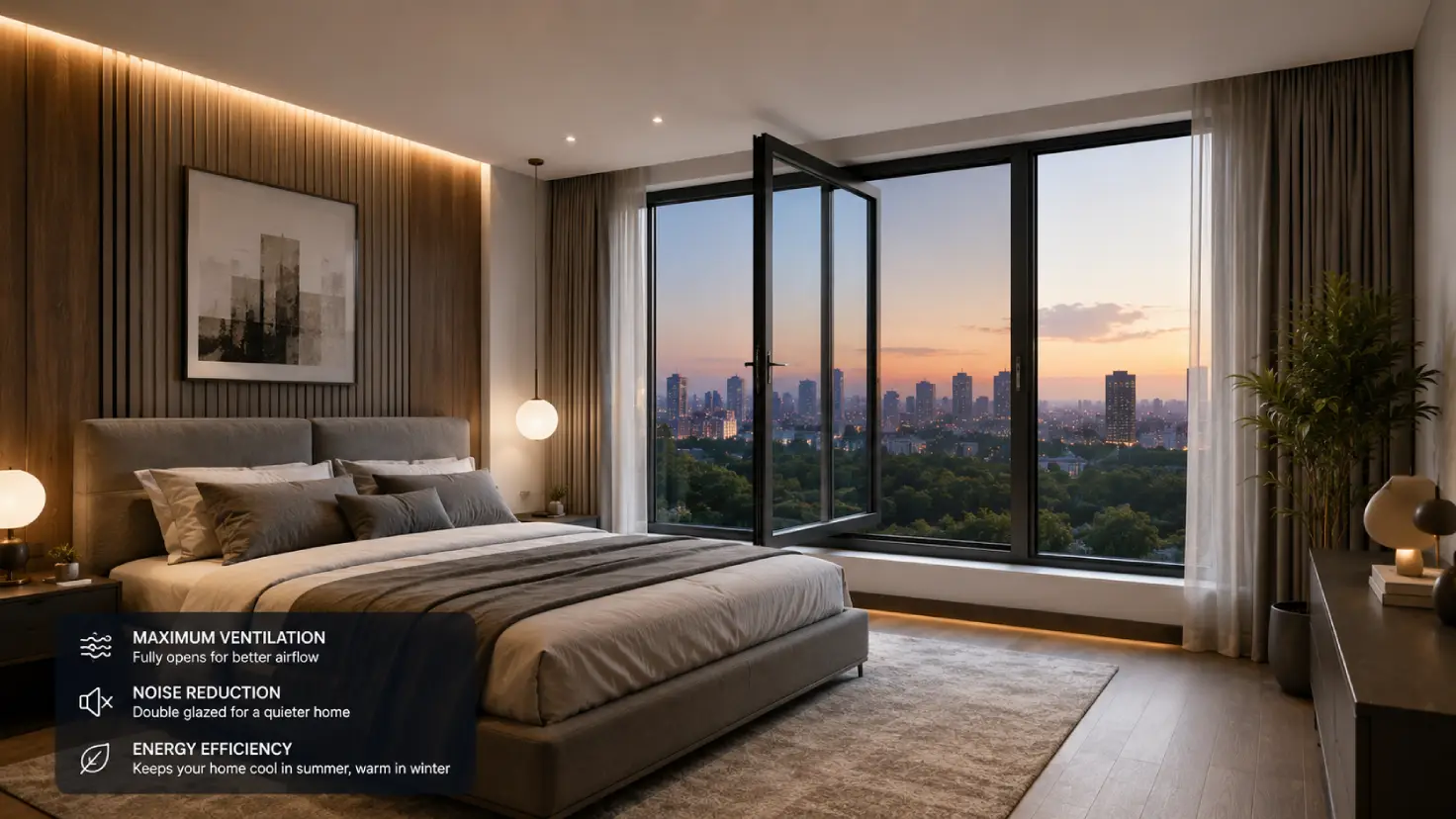
When a pivot window opens fully, air can come in from one side and go out the other. You get real cross-ventilation. On a hot day, that makes a room feel noticeably cooler, even without AC running.
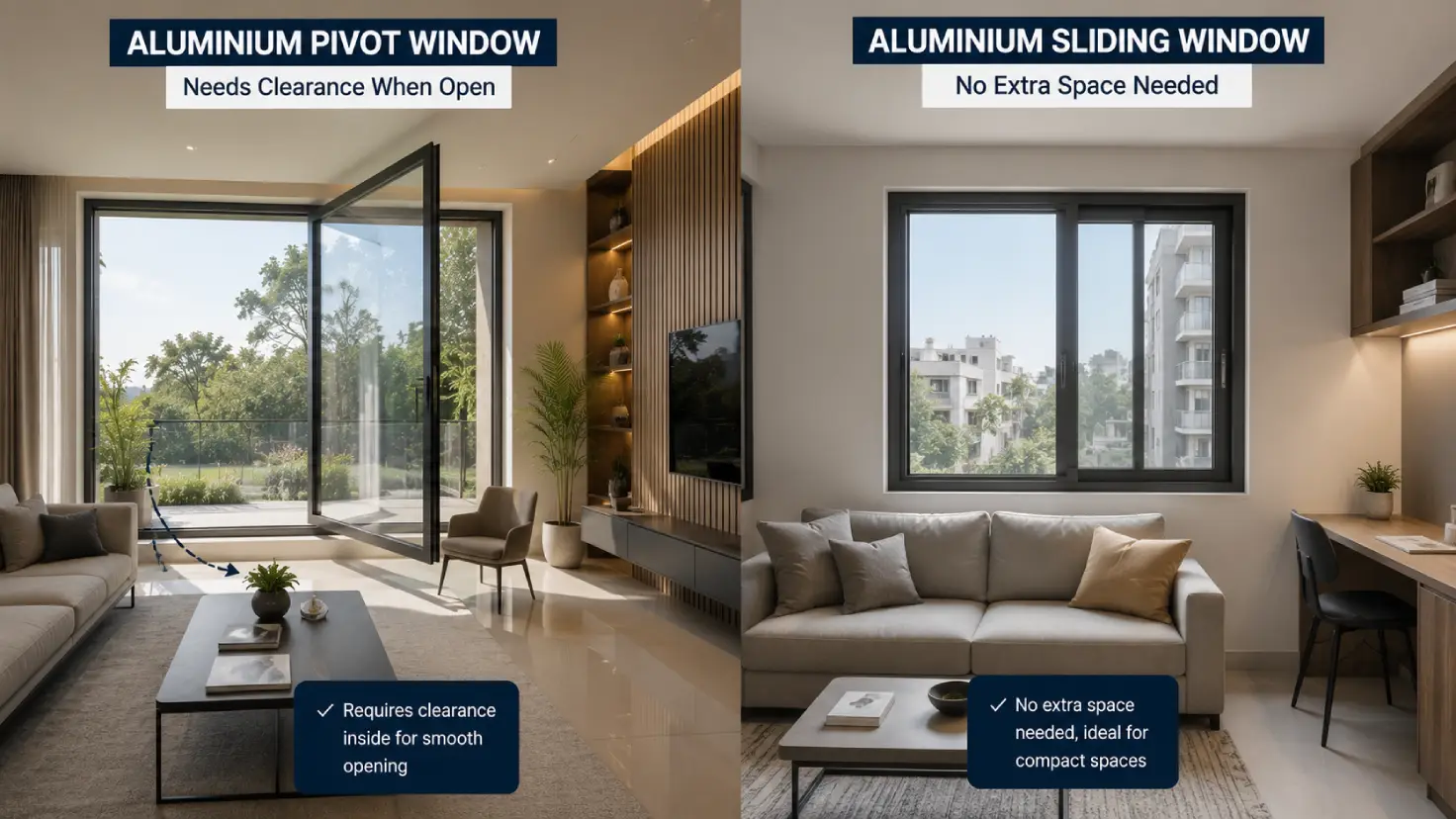
But here’s the thing: when a pivot window opens, part of it swings into the room. If you’ve got a table, a sofa, or curtains near that window, they’ll get in the way. You need some clear space around it.
Sliding windows don’t have that problem at all. The panel moves flat along the wall. Nothing swings, nothing bumps into your furniture. You could have a sofa pushed right up against it, and it would still open fine – Aluminium Pivot Windows vs Sliding Windows
The downside with sliding windows is that you only ever open half. One panel is always fixed. So the airflow you get is limited to 50% of the window size.
Neither is wrong. They just work differently. What matters is which one fits how you actually live.
Let’s Talk About Airflow Honestly
If ventilation is important to you, and in most parts of India, it should be, pivot windows do better.
A fully open pivot window lets air move through properly. It pulls air in from one direction and pushes it out the other. In a room that gets stuffy, that difference is real.
Sliding windows let in some air. Enough for a light breeze, enough to feel fresh. But it’s half the opening, so it’s half the airflow. Simple maths – Aluminium Pivot Windows vs Sliding Windows
That said, sliding windows make sense in rooms where you want controlled ventilation. A kitchen, for example, you want some airflow but not rain blowing straight in. A kid’s bedroom where you want a small gap at night. In those situations, sliding windows are actually the better fit.
How They Look in a Room
Pivot windows look different. That’s kind of the point of them.
When they’re closed, you get a large uninterrupted glass surface. The frames are slim. The whole thing looks clean and intentional. If your home has a modern design, high ceilings, big walls, open spaces, pivot windows fit right in. Architects love specifying them because they photograph well and they add something to a room.
Sliding windows are more neutral. They don’t stand out, which is actually useful in many homes. They work in both traditional and modern spaces. If you want the room itself to do all the talking and the windows to just sit quietly and do their job, sliding windows are the better choice.
Honest take? If you’re designing a showpiece room or a living space where aesthetics matter a lot, pivot windows are worth considering. For the rest of the house, sliding windows are perfectly good and nobody will think twice about them – Aluminium Pivot Windows vs Sliding Windows
Practical Stuff, Space, Maintenance, Daily Use – Aluminium Pivot Windows vs Sliding Windows
This is where things get real.
Pivot windows:
- Need clear space inside when open, at least enough for the panel to swing without hitting anything
- Work best in larger rooms with more wall and floor space
- Can feel tricky in tight rooms or narrow spaces
- Cleaning is actually easier than you’d think, you can rotate the window inward and clean the outside glass from inside your room
Sliding windows:
- Need zero extra space, the panel slides flat and stays flat
- Work in any room, any size, no planning needed around them
- The track at the bottom collects dust and needs to be wiped down regularly
- Very easy to open and close, no learning curve at all
If you’re fitting windows in a compact city apartment, sliding windows are almost always the more sensible option. If you’ve got a larger independent home or villa and you’re thinking about a few statement rooms, pivot windows start making sense.
Why Aluminium Works Well for Both
We work mostly in aluminium at TwinPro. Here’s why it makes sense for both window types.
Aluminium doesn’t warp. In humid coastal climates or areas with heavy monsoons, wood can swell and get stuck. uPVC can soften in extreme heat. Aluminium holds its shape year after year.
For pivot windows specifically, this is important. If the frame warps even slightly, the rotation mechanism won’t work properly. A straight, stable frame is not optional, it’s the whole thing. Aluminium gives you that reliability.
For sliding windows, aluminium tracks stay smooth. A good aluminium sliding window will open and close cleanly for years without grinding or sticking.
It’s also stronger at thinner sizes. That means slimmer frames and more glass, which is what makes modern windows look the way they do.
Security, What to Know -Aluminium Pivot Windows vs Sliding Windows
Both types can be made secure. But they work differently when it comes to locking.
Pivot windows need solid multi-point locks because the rotating mechanism can be a weak point if the hardware is poor quality. With well-made pivot windows, the locks are firm and the frame seals tight when closed. With cheap ones, you’ll notice the difference fast, they feel flimsy. Don’t cut corners here.
Sliding windows have a natural security advantage from the design itself. The fixed panel doesn’t move at all. The sliding panel can be fitted with anti-lift pins so it can’t be lifted out of the track from outside. Both together make for a solid, secure window.
Bottom line, quality matters more than window type when it comes to security. A well-made version of either is fine. A cheap version of either is a problem.
Also you can check MyGlass by NGA
Noise, Does Either One Keep Sound Out Better?
If you live near a busy road, a market, or somewhere noisy, you probably care about this.
Both types can be fitted with double-glazed glass, which is your best option for noise reduction. But the seal around the frame matters just as much as the glass itself.
Pivot windows press tight against the frame when closed. That gives a better seal and keeps more sound out.
Sliding windows have a small track gap by design. If the brush seals on the edges are of good quality, noise stays out reasonably well. If they’re not, sound comes through.
For bedrooms, home offices, or any room where quiet matters, we’d suggest pivot windows with double glazing. The seal is better. You’ll notice the difference on a noisy day.
What About Cost?
We’ll be direct: pivot windows cost more.
The hardware, the mechanism, and the precision needed to install them properly, it all add up. A good aluminium pivot window is a bigger spend than a comparable sliding window.
Sliding windows give you good quality and good performance at a lower price. You’re not compromising much, just getting something simpler.
If you’re fitting out a full apartment or a multi-room project with a fixed budget, sliding windows make sense for most rooms. If you’re doing a specific room where you want something that looks and performs at a higher level, pivot windows are worth the extra cost.
Many of our customers mix both. Pivot windows for the living room or master bedroom. Sliding windows for the rest of the house. That balance tends to work well.
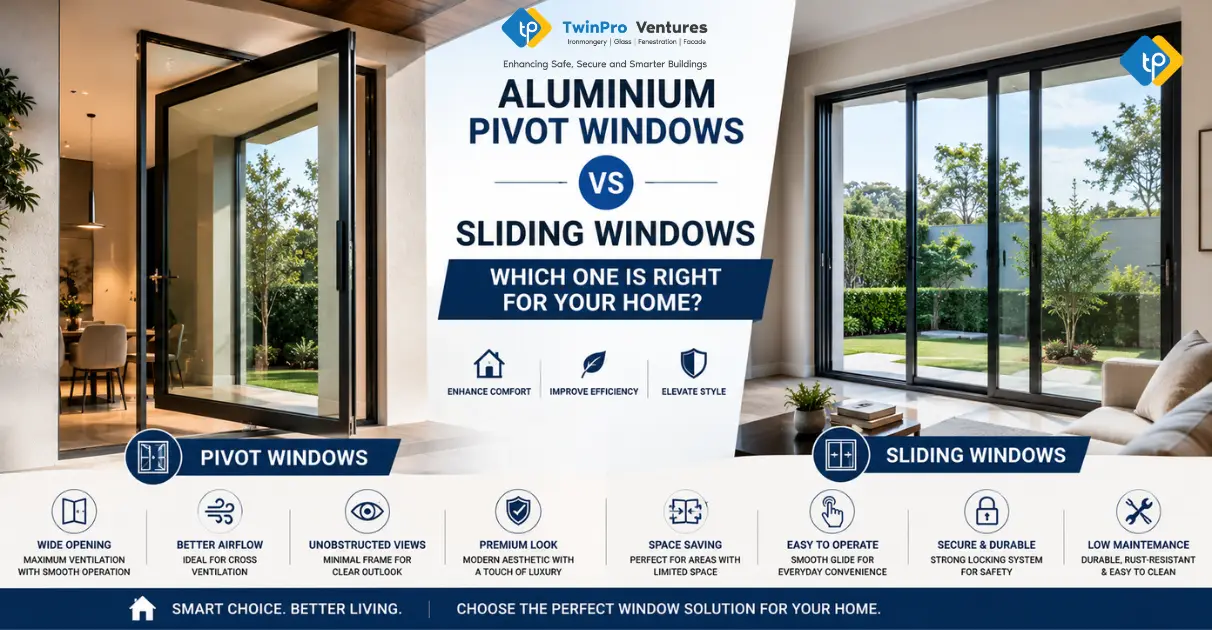
Quick Side-by-Side – Aluminium Pivot Windows vs Sliding Windows
| Aluminium Pivot Windows | Sliding Windows | |
|---|---|---|
| Airflow | Full opening, better ventilation | 50% opening, moderate airflow |
| Space needed | Needs clearance when open | No extra space needed |
| Look | Modern, minimal, architectural | Neutral, works anywhere |
| Cleaning | Easy, rotate inward to clean outside | Track needs regular dusting |
| Noise | Better seal when closed | Depends on brush seal quality |
| Cost | Higher | More affordable |
| Best for | Larger rooms, modern homes | Apartments, compact spaces |
Conclusion – Aluminium Pivot Windows vs Sliding Windows
Simple ways to think about it.
Choose aluminium pivot windows if:
- You’re building or renovating a modern home
- Good airflow and ventilation matter to you
- You have room for the window to open without hitting furniture
- You want a few rooms to look and feel a step above the rest
Choose sliding windows if:
- You’re in an apartment or a smaller space
- Budget is a real factor
- You want something easy to use every single day
- You have kids or elderly family members at home
And if you’re not sure? Use both. Pick pivot windows for one or two rooms where it makes sense. Use sliding windows everywhere else. That’s what a lot of our customers end up doing, and it works.
At TwinPro, we make both window types. We’re not going to push you toward the more expensive one just because it costs more.
What we will do is look at your actual space, the room sizes, the direction the windows face, where you live, what your budget is, and tell you what actually makes sense for you.
If you’re mid-planning or just starting out, reach out to us. A 10-minute conversation can save you a lot of second-guessing later.
Get in touch with TwinPro Ventures. We’ll help you figure it out.
Frequenlty Asked Questions – Aluminium Pivot Windows vs Sliding Windows
1. Which is better, aluminium pivot windows or sliding windows?
The choice depends on your needs. Aluminium pivot windows offer better ventilation and a modern look, while sliding windows are more space-efficient and budget-friendly – Aluminium Pivot Windows vs Sliding Windows
2. Are aluminium pivot windows more expensive than sliding windows?
Yes, aluminium pivot windows generally cost more because they use specialized hardware and require precise installation compared to standard sliding windows – Aluminium Pivot Windows vs Sliding Windows
3. Do aluminium pivot windows provide better ventilation than sliding windows?
Yes, aluminium pivot windows can open wider, allowing greater airflow and improved cross-ventilation compared to sliding windows – Aluminium Pivot Windows vs Sliding Windows
4. Are sliding windows suitable for small apartments?
Yes, sliding windows are ideal for compact spaces because they open horizontally without requiring additional clearance inside or outside the room.
5. Which window type is better for noise reduction?
Aluminium pivot windows often provide better noise insulation due to their tighter seal when closed, especially when paired with double-glazed glass.