


Toughened Glass vs Laminated Glass: Which One Should You Choose?
Toughened vs Laminated Glass: Which One Should You Choose?
Someone asks us this almost every week: toughened vs laminated glass, which one do I actually need? And every time, we give the same honest answer. It depends. Not on price alone, not on what looks nice in the brochure, but on where the glass sits and what it has to survive.
This is not going to be a textbook chapter. We have installed both types on real buildings across Coimbatore, Chennai, and Bangalore, and we will just tell you what we’ve learned. No jargon you need a dictionary for. No filler. Just the stuff that actually helps you pick right the first time, so you are not redoing a facade six months later because someone guessed wrong at the design stage.
What’s the Actual Difference?
Both glasses start out the same way. The type of glass found in a regular window. Then they undergo various processes, that is where it is divided.
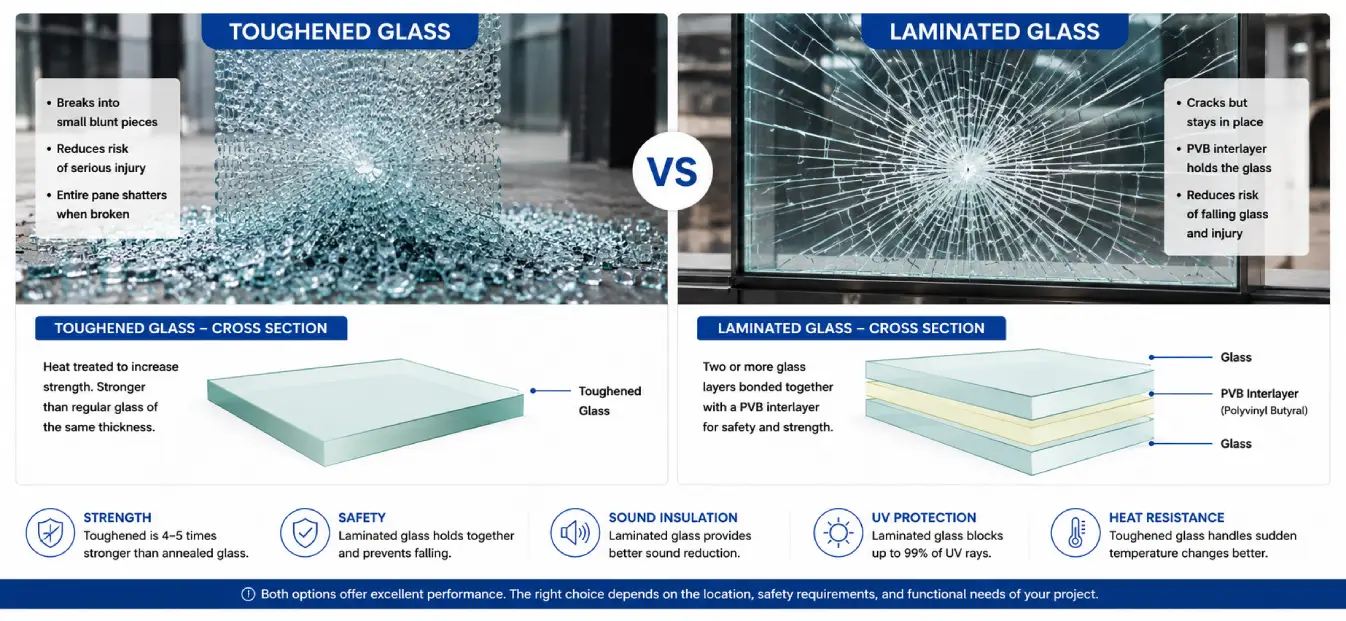
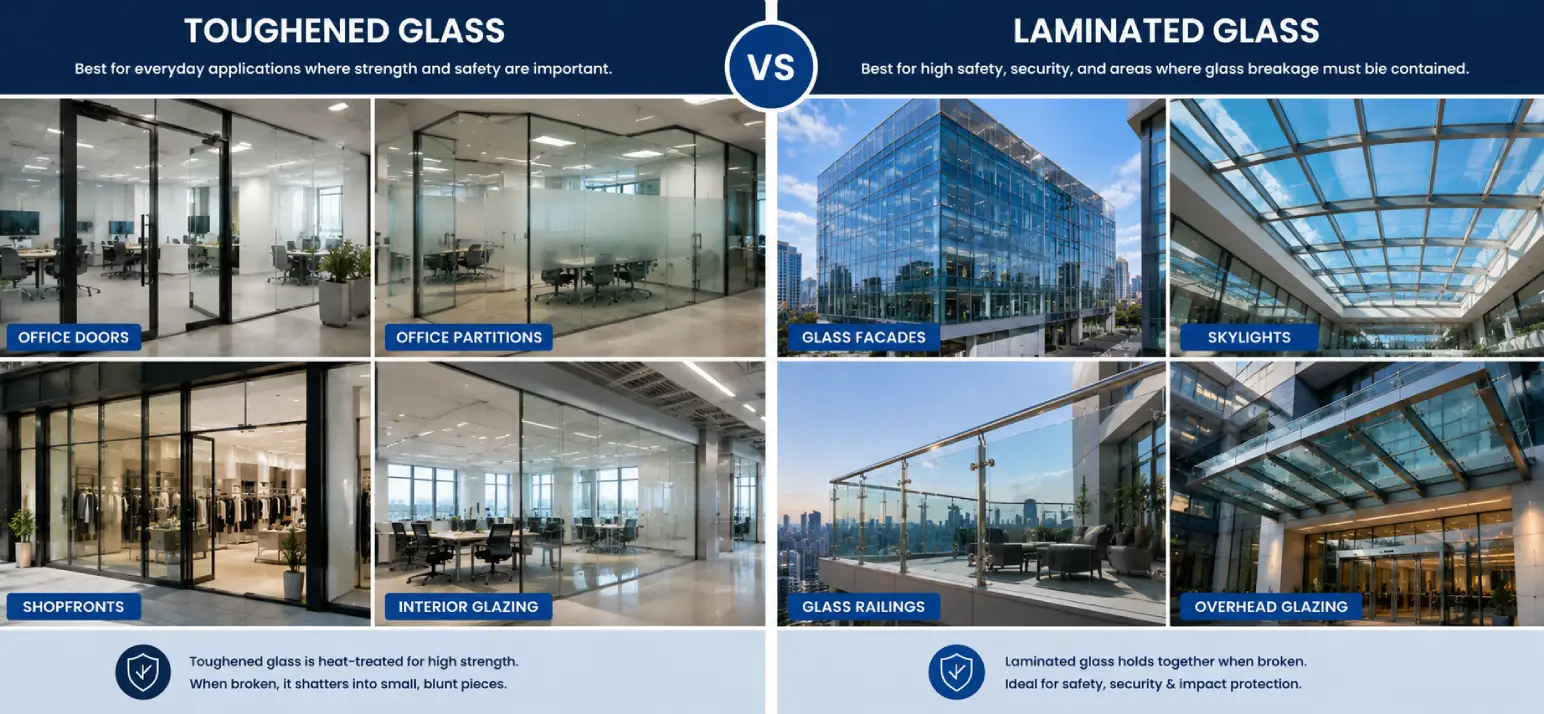
People also refer to toughened glass as tempered glass and it is heated to approximately 620°C and then rapidly cooled. This causes the outside surface to be compressed and the inside surface to be under tension. This in plain language means that the glass is made about 4-5 times stronger than normal glass. If it does break, then it is not sharp daggers. Falls apart into small blunt fragments. Easy to clean up, but far less dangerous than a shard through the hand.
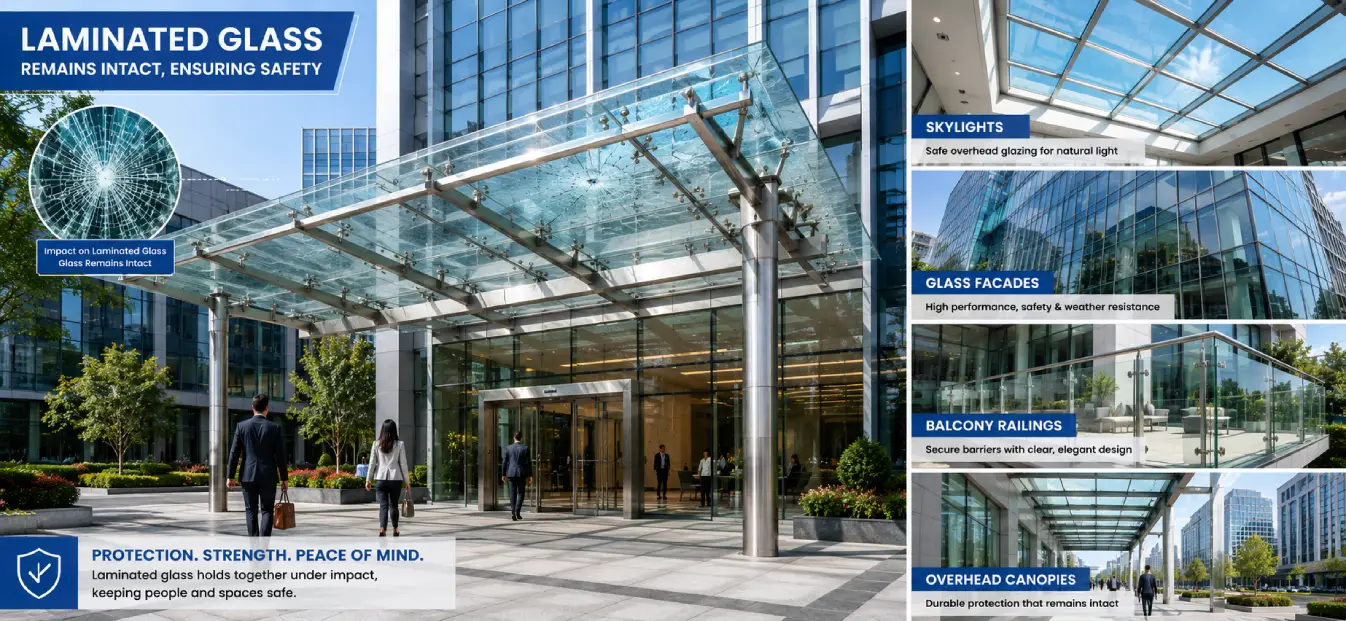
Laminated glass doesn’t operate in the same way. You glue two glass sheets together using an adhesive that is strong plastic in between, typically called PVB. Imagine if it’s a sandwich. This glass cannot be broken apart if it is broken. The pieces remain “glued” to that plastic layer. There will be a spider web of cracks, however, the glass remains intact and will still hang in the frame.
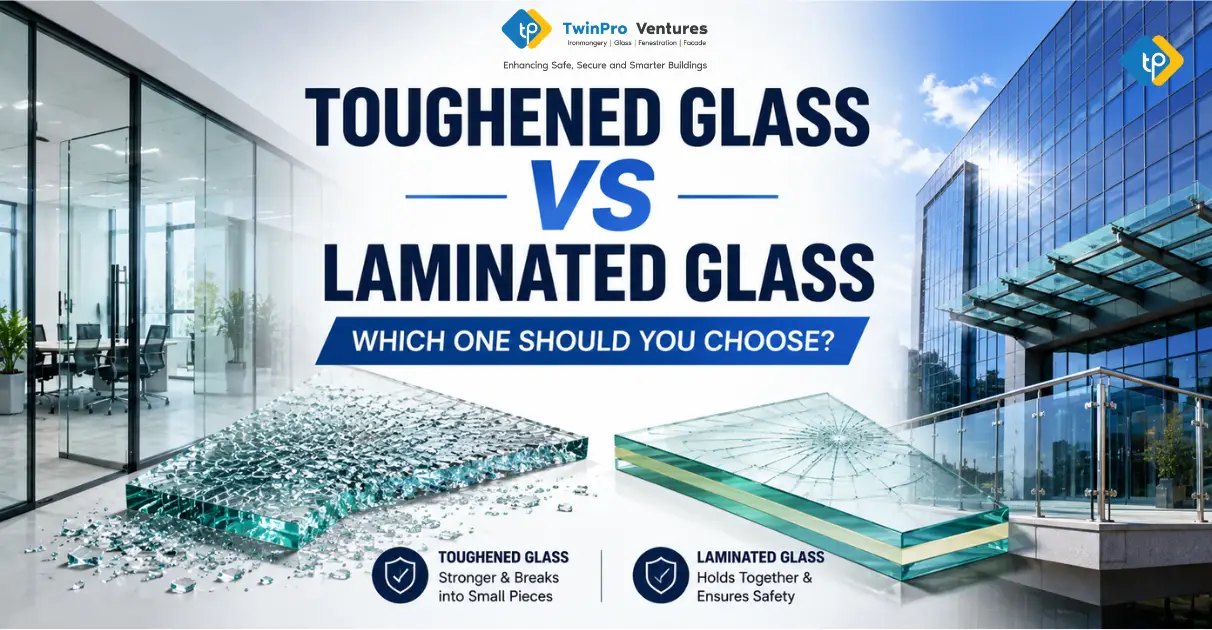
Well, that’s all in one paragraph. One type is shattered. The other type is crackable and sticky. All other differences, the cost, the use cases, the safety rules come from this one basic difference. Remember this as you read on as all the different considerations of toughened glass are connected to laminated glass are rooted in this.
Toughened Glass Wins on Raw Strength
If you just want glass that can take a beating, go with toughened. It handles knocks and bumps well. It also deals with heat better, which matters here in Tamil Nadu where the sun does not play around. That is why you see it everywhere, glass doors at shops, office partitions, balustrades near staircases, all the places that get touched and bumped all day long.
But this is the catch. When toughened glass does give up, it gives up completely. The whole sheet shatters and drops in seconds. Fine for a door at ground level. Not fine for a skylight above someone’s head, or a high facade panel twenty floors up. You do not want a full pane falling on anyone.
So when you are weighing toughened vs laminated glass, do not just ask “which one is stronger.” Ask what happens after it breaks. That second question matters just as much, maybe more.
Laminated Glass Wins on Safety
This is the bit architects and site engineers care about the most, and they are right to. Laminated glass does not just resist cracking. It resists falling apart once it does crack. That plastic layer holds everything in place. So if someone bumps into it, or a stray object hits it, you do not get glass raining down on the people below.
This is exactly why Indian building codes keep pushing laminated glass for:
- Skylights and any overhead glazing
- Balcony railings and glass barriers
- Facades on tall commercial buildings
- Crowded spots like malls, airports, hospital entrances
- Anywhere near a staircase or walkway where a fall is possible
For these safety critical spots, the toughened vs laminated glass question really has only one answer. IS 2553 and IS 14900 both point toward laminated specs for overhead or fall risk areas. Skip this rule and you will hear about it during a building audit, guaranteed.
We have sat through enough of these audits to know one thing. Fixing a missed laminated glass requirement after the structure is built costs way more than getting the spec right at the start. Settle the toughened vs laminated glass call on paper, not on site.
A Quieter, Cooler Building
Nobody thinks about sound until they have moved into a building near a busy road and realized the noise never stops. This is where laminated glass earns its keep without anyone noticing, until you put it next to a building that skipped it.
That same plastic layer that holds broken pieces together also dampens sound. Laminated glass blocks outside noise noticeably better than toughened glass of the same thickness. If your site is near traffic, a railway line, or under a flight path, this isn’t a small detail.
It also blocks heat and UV better. Laminated glass can stop up to 99% of UV rays. That means your furniture, flooring, and curtains fade slower over the years. Toughened glass does not do this on its own, you would need a separate UV film or coating, and that’s just more cost stacked on top.
Toughened Glass Wins on Cost
Now let us talk money, because that is usually what settles the argument anyway. Toughened glass is cheaper to make and install than laminated glass of the same size. The process is simpler. There is no plastic layer to source or bond. Fabricators turn it around faster too.
So if your budget’s tight and you are not dealing with height or fall risk, partitions, regular shopfronts, cabin glazing, toughened glass does the job well without burning a hole in your numbers. Nothing wrong with that choice when it fits.
But do not let price alone drive the toughened vs laminated glass decision. We have watched projects save money here and pay for it later during a compliance check, or worse, after an accident. Spend the extra rupees where the rules actually demand laminated glass. That part is not negotiable, whatever the budget sheet says
Quick Comparison
In case you are reading this standing on site with a client waiting:
| Factor | Toughened Glass | Laminated Glass |
| Strength | Handles knocks wel | Strong, plus the inner layer adds extra hold |
| What happens when it breaks | Shatters and falls away | Cracks but stays in one piece |
| Sound blocking | Average | Better |
| UV protection | Weak on its own | Blocks almost all of it |
| Where it is used | Doors, partitions, shopfronts | Facades, skylights, railings, overhead spots |
| Cost | Lower | Higher, but worth it where safety demands it |
So Which One Do You Pick?
Truth is, the toughened vs laminated glass question is not really about finding the “better” glass. It is about matching the glass to the job and the people walking under it every day. This is roughly how we guide clients at Twinpro.
Pick toughened glass when:
- You want strong, affordable glass for doors, partitions, or shopfronts
- The glass won’t sit overhead or up high
- You’re working against a tight timeline
- The spot gets heavy foot traffic but low fall risk
Pick laminated glass when:
- The glass sits overhead, on a facade, or above people
- You are dealing with traffic noise or a flight path nearby
- Your structural engineer or the building code asks for it
- You want real UV protection indoors
- You’re working on balconies, railings, or anything above a certain height
Honestly, most good commercial projects use both. Toughened where strength and budget matter most, laminated wherever height or crowd risk pushes safety to the top of the list. We rarely spec a whole building in just one type, and you probably shouldn’t either.
We’ve Learned On Actual Sites
Drawings look tidy on paper. Sites never are. We have worked on enough commercial jobs to know that the gap between what is drawn and what gets built usually comes down to a few small decisions nobody double-checked.
This is a pattern we keep running into. A mid rise building gets toughened glass on the ground floor shopfront, which makes sense, heavy traffic, lower budget at that stage, low risk. But then the same glass type quietly carries up to the fifth floor canopy, simply because nobody went back and revisited the choice as the floors went up. That gap shows up during an audit, and by then it is an expensive fix, not a cheap one.
Weather matters too. Coimbatore and Chennai do not ding on the type. Toughened glass copes well with quick temperature swings, useful on a west facing wall that takes the full afternoon sun. Laminated glass, especially with a low E coating added, manages heat gain better over time, and that shows up later as lower cooling bills, something facility managers actually notice once the building’s running.
Installation differs a bit too. Once toughened glass is made, you can not cut or drill it on site. Every measurement has to be locked in before it goes to the factory, so your drawings need to be final before you place that order. Laminated glass gives you slightly more room in some cases, since the individual layers can sometimes be worked on before they’re bonded, though this depends on the fabricator and thickness. Either way, get your site measurements right before ordering. Saves everyone a painful reorder.
We bring all of this into every glazing conversation we have with clients, because a spec sheet only tells half the story. The rest comes from having actually installed this stuff and seen where it goes wrong.
One more thing worth saying. Cost estimates done early in a project rarely account for the toughened vs laminated glass mix a building actually needs once the design firms up. We’ve seen budgets built around an all toughened assumption, only to discover during the structural review that half the upper floors legally need laminated panels. That kind of surprise is avoidable. A short conversation with your glazing supplier at the design stage, before quantities are locked, saves a much harder conversation with the client later.
Frequently Asked Question – Toughened vs Laminated Glass
- 1. Can laminated glass also be toughened?
Yes. Each glass layer is toughened before being laminated, giving you both high strength and added safety. It’s ideal for facades and overhead glazing. - 2. Does toughened glass need any special care?
No. Clean it like regular glass. Its strength comes from the manufacturing process and doesn’t wear off over time. - 3. Which one handles heat better?
Toughened glass handles temperature changes well, while laminated glass offers better UV protection and improved indoor comfort. - 4. Is one type more eco-friendly than the other?
Not significantly. Both are recyclable, and overall building design has a much bigger impact on sustainability than the glass type.
Conclusion – Toughened vs Laminated Glass
Don’t lose sleep over toughened vs laminated glass before a deadline. At Twinpro, we work directly with architects, builders, and project consultants across Coimbatore, Chennai, and Bangalore, and we help spec the right glass for every part of a building, from the front door to the top floor.
Talk to us before you lock your glazing drawings. We’ll go through your project with you, tell you straight where toughened glass works fine and where laminated glass isn’t optional, and help you get the call right the first time.