


Best Facade Materials for Commercial Buildings in India
Best Facade Materials for Commercial Buildings in India
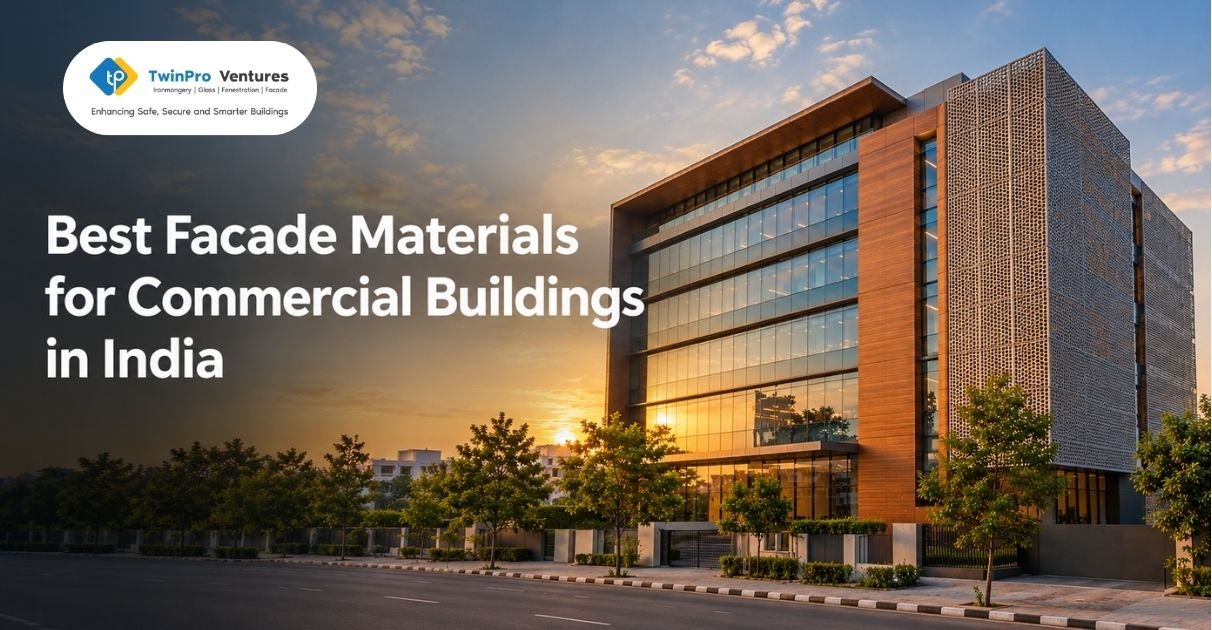
Most people judge a commercial building from the road, in about five seconds. What they’re looking at is the facade, and the facade materials behind it decide much more than that first impression. They affect how hot the rooms get in the afternoon, how much the building costs to clean, and whether you’ll be calling a contractor for repairs after only a few monsoons.
We work with architects, builders and project managers on facade solutions all the time, so we hear the same questions again and again. Which material is best? Which one is cheapest? Which one will still look okay in ten years? There’s no single answer, but there are good answers for specific buildings, and that’s what this post is about: the best facade materials for commercial buildings in India and when each one makes sense. We’ll go through the main options one by one, say what we like and dislike about each, and tell you what to check before you spend any money.
Start with the weather
Before you look at samples, think about where your site is. India isn’t one climate. A glass heavy building in Hyderabad gets baked from March to June. A building near the sea in Kochi or Chennai deals with salty air all year, and that eats cheap metal coatings faster than you’d think. In Delhi it’s dust and smog, so surfaces get dirty quickly. In Kerala or the Konkan the rain is so heavy that water has to drain properly or it finds its way inside.
So a material that works well in Pune might give you trouble in Mumbai. The same facade materials can behave quite differently from one city to the next, and brochures rarely mention that.
Along with the weather, we usually ask six things. How tall is the building? What does the fire authority require? What is the maximum weight the structure can safely support? Who will clean it, and how will they reach it? What’s the real budget, and for how many years? And how should it look from the road? Once you answer these, the shortlist gets a lot shorter.
ACP
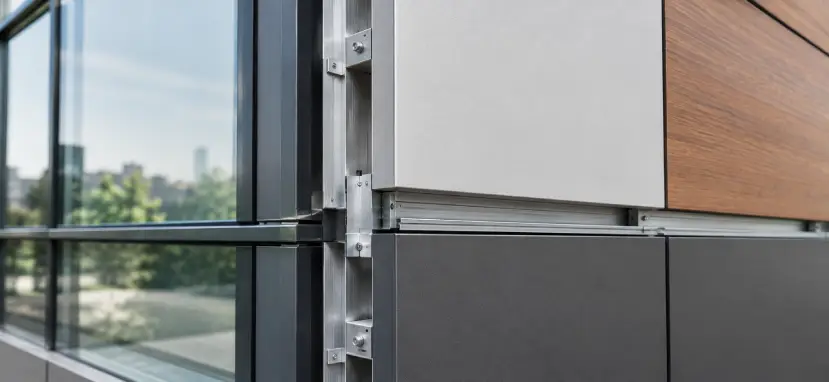
ACP stands for aluminium composite panel. It’s a core with a thin aluminium sheet bonded to each side. It’s light, easy to cut and bend, and it comes in plenty of colours and finishes, including ones that imitate wood and metal. You’ll find it on shopfronts, showrooms and mid rise offices everywhere, mostly because it’s quick to install and kind to the budget.
The thing to watch is the core. A standard polyethylene core burns. On a tall or crowded building that is a serious problem, so ask for a fire retardant or non combustible core, and ask to see the test certificate. A brochure won’t do.
Quality varies a lot too. Panels with thin aluminium skins and weak coatings fade and bow after a few years, even when they looked identical to a good panel on the sample board. Ask about skin thickness and the coating warranty before you order.
We’d use ACP on mid rise offices, retail fronts and any project where the timeline and budget are tight.
HPL
HPL, or high pressure laminate, is made by pressing layers of paper and resin together under very high heat and pressure until it becomes a hard, dense board. It doesn’t sound exciting, but it holds up well. Of all the facade materials we discuss with clients, it’s the one people underestimate.
It copes with sun and rain, resists scratches, and can look like timber or stone without needing the upkeep of either. It also works nicely in a ventilated facade, which just means there’s a small air gap behind the panel so heat can escape instead of soaking into the wall.
It costs more than ACP, and it needs proper fixing and clean edge detailing, otherwise it looks sloppy. We think it suits corporate campuses, hotels and educational buildings, where you want a warm look that doesn’t need much care.
Glass
Glass is what most people imagine when they think of a modern commercial building: IT parks, banks, airports. It looks great, but a fully glass face in an Indian summer turns into an oven if you choose the wrong type. These are the terms you’ll hear:
Toughened glass has been heat treated, so it’s several times stronger than normal glass and breaks into small, blunt pieces.
The laminated glass has a layer of plastic between two pieces of glass and therefore, if one pane is broken, the other remains intact.
Double glazed unit (DGU) comprises two panes with a sealed gap between reducing heat and noise.
Low E glass has a thin coating that bounces heat back, yet allows light to pass through.
Most commercial projects are a combination, such as a laminated or toughened pane in a double glazed unit, which has a solar control coating.
People often forget about the hardware. Heavy glass is held by spider fittings, which are metal arms gripping the corners of each pane, and patch fittings, which are clamps along the edges. If those are weak, the glass will sag, rattle or leak however good it is. Among all the facade materials, glass gets most of the attention and its fittings get almost none. That bothers us, because door and glass hardware is what we supply.
Natural stone
Granite, sandstone and limestone all send the same message, that the building isn’t going anywhere. Stone lasts for decades, doesn’t fade, and since India has so much of it you can often buy locally and save on transport.
The downsides are fairly obvious. It’s heavy, so the structure has to be designed for it. Installation takes longer. Light coloured stones can stain, so ask about sealing. And use dry fix anchors, meaning metal brackets that hold each slab, rather than depending only on adhesive.
You’ll see it most on banks, government offices and high end hotels, and there’s a good reason for that.
Terracotta
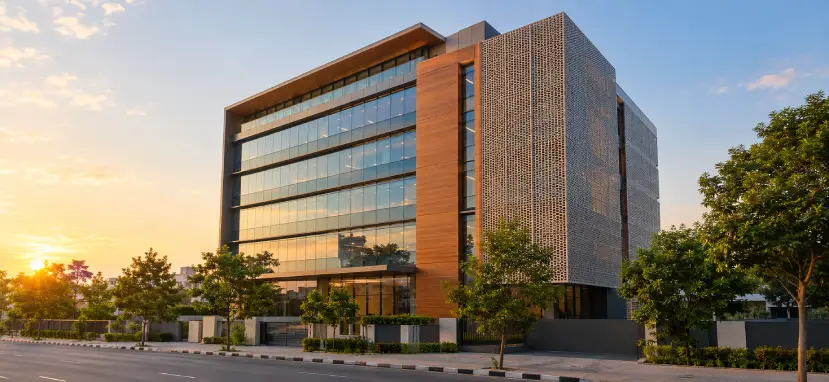
Terracotta is fired clay, and the colour comes from the clay itself, so it can’t fade the way paint can. It looks warm and earthy, and in a ventilated system it handles heat well. On the other hand, it’s brittle while being handled, it costs more than ACP or fibre cement, and there are fewer suppliers, so order early. Boutique offices, campuses and hospitality projects get the best out of it.
Fibre cement and GRC
Fibre cement boards are made up of cement and fibres and are formed into strong, flat boards during curing. A similar product is GRC (Glass Fibre Reinforced Concrete), which can also be cast in curves and shapes. Both are not show stealers if the finish is good, but they are fire resistant, tolerates the rain and humidity, and are not so expensive as many options here. They crack if the fixing is not done carefully. They are widely used in hospitals, schools, warehouses and industrial buildings.
Metal panels and screens
Aluminium or steel sheet works as cladding and also as shade. A perforated screen, a metal mesh with patterns of holes that allow air and light to filter through, can cut out glare and surprisingly amount of heat from the building, and a screen in front of a glass wall can cut a surprising amount of heat from a building. They must be well coated (PVDF paint) to stand up to the sun and salt, and thin sheets are easy to dent. Typically they’re found in malls, parking structures, and glass fronts.
A quick example
Suppose there is, in Chennai, a four story building near the sea that has an office building on each floor. While full glass may look appealing, it will lead to higher air conditioning costs each month as the heat of the day hits the building. Perhaps a sensible combination is solar control glass at the entrance, HPL on long walls where wood colors are compatible with the brand, and a metal screen over the west face to reduce the sun effect. Salt in the air means marine grade coatings on every metal part. That’s a very different answer from the same office in a dry, dusty city, and it’s why we don’t recommend one material for everything.
Mixing materials
Only a few commercially built good buildings have a single material. A typical option is to have glass on the front, HPL or ACP on the sides, stone at the bottom and metal screens in the middle sun exposure. Mixing facade materials this way keeps cost under control and stops the building looking flat. Our rule is simple: every material should have a job. If you can’t explain why a panel is there, remove it.
Fire safety
Nobody enjoys this part, but read it. The National Building Code sets fire requirements by the height and use of a building, and the local fire authority has the last word. Taller and more crowded buildings face stricter rules, and fire rating is the thing that can remove facade materials from your shortlist overnight.
Before you commit to a panel, check three things. Is the core non combustible, or does it come in a fire retardant grade? Can the supplier show real test reports? Has your fire consultant looked at the exact product and fixing detail? If anyone answers “not sure,” stop there. Fixing a problem on paper costs almost nothing, and fixing it on site costs a lot.
Fixing
Whatever supports a panel is as good as the panel itself and that includes brackets, rails, anchors, sealants and gaskets. A large number of facade failures begin there. When the fixing is weak, it causes rattling, leaks and in some instances panels may come loose. Request the entire system instead of the sheet. Any supplier who only discusses the panel price and disregards brackets and sealants is overlooking the toughest part! This is true for all of the facades made of the above materials.
Cost
Everyone asks about cost, and the answer depends on grade, size and supplier. We look at it in three layers. Upfront cost comes first: ACP and fibre cement are usually easiest on the budget, while stone and high grade glass cost the most. Then there’s running cost, which covers cleaning, resealing and repainting and adds up faster than people expect. Last is replacement cost. A cheap panel that fades in five years effectively gets paid for twice, and a mid priced material that lasts twenty years often works out cheaper than a budget one you replace in year seven. So when you compare facade materials, compare them over 15 to 20 years, not over a single quotation.
Common mistakes
These are the mistakes we see most. People choose by price per square foot and forget that the cheapest panel is often the most expensive by year ten. They leave fire rating until the end, which can force a redesign. They skip the mock up, when a sample panel on site, checked in morning and evening light, would have told them a lot. They forget the fixing system. And they don’t plan cleaning access, even though a facade nobody can reach is a facade nobody cleans. None of this comes from picking bad facade materials. It comes from rushing the decision.
It also helps to put a few direct questions to any supplier before you order. Request fire test certificates. Inquire about the warranty on the coating. Find out where the brackets and sealants are being obtained from and if they have been used with the panel. Request a full-size sample for a prototype, and inquire regarding lead time and what would happen if it were to be late. Ask to speak to someone who has used the product in a similar climate. A good supplier answers all of that calmly. A shaky one tends to dodge a couple of them.
Which material for which building
Solar control glass with ACP or HPL accents is typically a good choice for offices and IT parks. Hospitals are more inclined to opt for non combustible materials like fibre cement, and for daylight use, glass. Across commercial premises such as malls and showrooms, ACP, metal screens and glass are used. HPL, fibre cement or terracotta and stone, HPL and glass together are used in school and colleges, and in hotels. This is a starting point, as your site, budget and local rules will affect the answer. The best facade materials are those that are suitable for your building and not those that were fashionable to someone else.
FAQ – Facade Materials
Which one is the cheapest as a start up expense?
Typically of ACP or fibre cement. Nevertheless, first run the 15 to 20 year numbers.
Is ACP safe for tall buildings?
With a fire retardant or non combustible core and if it meets local fire rules. Have it approved by your fire consultant.
Which facade materials last the longest?
Stone and terracotta have the longest record, and good glass with quality sealants lasts well too. Cheap, thin or badly finished panels don’t.
What are the top 10 facade companies in India?
Twinpro, Aludecor, Fundermax, Saint Gobain, Schüco, Jindal Aluminium, Aluplex, Tata BlueScope Steel, Everest Industries, Permasteelisa Group, and Facade Global.
Which material is best for exterior walls?
ACP panels are ideal for modern facades, while stone and porcelain offer durability and a premium finish.
How TwinPro Ventures can help
We supply door and glass hardware and facade solutions for commercial projects. We don’t construct the building. We can guide you in the selection of the appropriate system, fittings and finish so that what is on the drawing is the same as what is on the wall.
It’s much easier to select the appropriate materials for your facade if someone who has dealt with them on a regular basis views your plan. Submit your drawings, site information and budget and we’ll let you know exactly what we would choose and why!
Projecting a business project in India? Talk to us before you finalise your facade materials. Message the TwinPro Ventures team today and get your facade right the first time.