


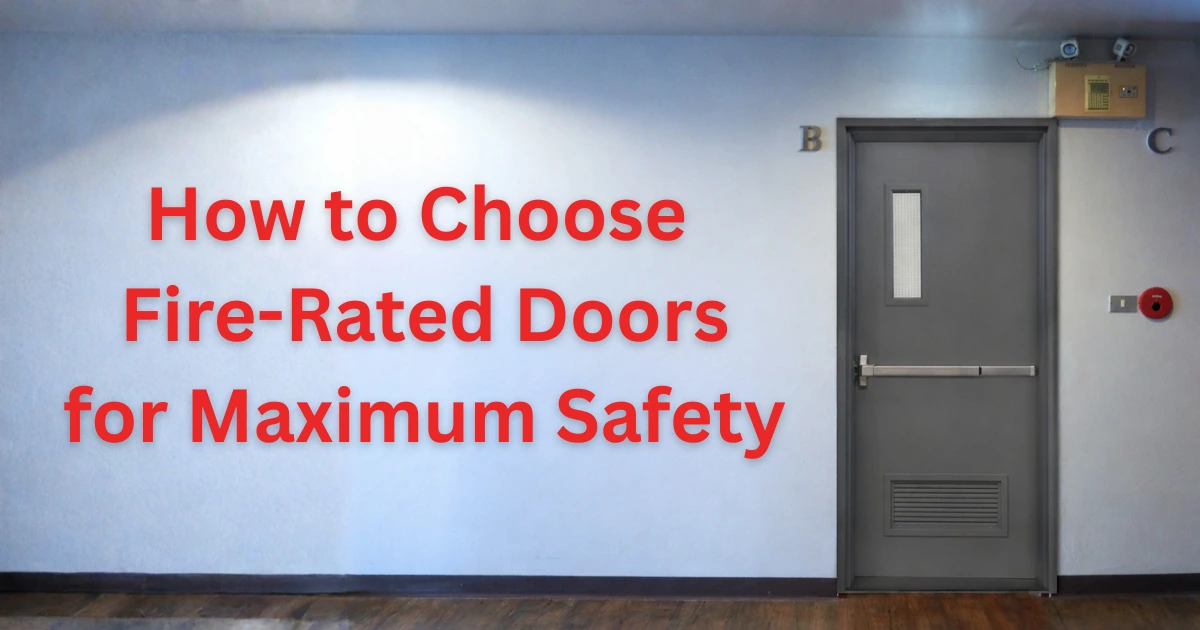
How to Choose Fire-Rated Doors for Maximum Safety
When we talk about fire-rated doors, we are talking about a life safety system. Yet, most people still treat it like a regular door. That is the first mistake.
We have worked on multiple commercial and industrial projects and we see a pattern. Buyers focus on price, finish or just a certificate. However, real performance depends on fire containment, smoke control and system integrity.
So instead of overcomplicating things, we simplify the decision. We focus on three things: fire rating, application and certified system. Because in reality, that is what determines whether the door will perform in a fire.
Fire Rating Guide: 30, 60 and 120 Minute Fire-Rated Doors
Choosing the correct fire-rated doors starts with understanding fire ratings. This is where most decisions go wrong.
We break it down clearly:
- 30 minutes for low-risk areas
- 60 minutes for standard commercial spaces
- 120 minutes for high-risk industrial and staircase zones
Now here is the truth. A higher rating is not always better. Instead, we match the rating to fire load, occupancy and evacuation time.
| Fire Rating | Application Area | Risk Level | Our Approach |
| 30 Minutes | Small offices | Low | Limited use |
| 60 Minutes | Corridors, commercial | Medium | Standard |
| 120 Minutes | Industrial, staircases | High | Mandatory |
Fire Door Specifications and Thickness That Actually Matter
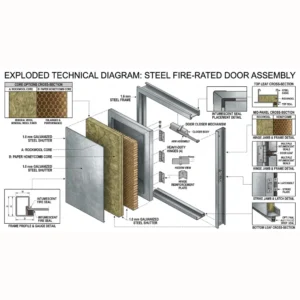
We define fire-rated doors as a complete engineered system. So here are the actual specifications we work with:
- Door Thickness: 45 to 50 mm
- Shutter: 1.0 mm galvanized steel
- Frame: 1.6 mm steel
- Core Options: Honeycomb, Rockwool, Glass Wool
- Fire Rating: 60 / 120 minutes
- Maximum Size: Up to 3000 mm × 3000 mm
However, specs alone are not enough. We align these with tested systems and certified assemblies.
We also ensure essential hardware is included:
- Fire-rated hinges
- Door closers
- Intumescent fire seals
Because without hardware compatibility, even the best door will fail.
Steel Fire-Rated Doors vs Fire-Rated Shutters
Not all fire-rated doors serve the same purpose. So we always define the application first.
| Feature | Fire-Rated Doors | Fire-Rated Shutters |
| Use | People movement | Large openings |
| Location | Offices, staircases | Warehouses, factories |
| Operation | Hinged | Rolling/sliding |
| Size Capacity | Limited | Large spans |
For standard openings, we use steel fire-rated doors. But for large openings, shutters are not optional. They are essential.
This is where many projects fail. They try to use doors where shutters are required. That decision does not survive a real fire.
Fire-Rated Door Certifications and Standards You Must Verify
Most buyers stop at certified. That is not enough. We always verify the actual standard and testing method. We align with:
- EN 1634-1
- BS 476 Part 22
- Underwriters Laboratories
- National Fire Protection Association
- International Organization for Standardization
- Bureau of Indian Standards
Our systems are built using System Schröders licensed systems.. This ensures tested assemblies instead of random fabrication. For official fire safety codes, you can refer to this NFPA website.
Because here is the reality. A certificate without a tested system is meaningless.
Fire-Rated Opening: Why the System Matters More Than the Door
This is the biggest misconception in the market. A fire-rated door alone does nothing. Real safety comes from the fire-rated opening, which includes:
- Door
- Frame
- Hardware
- Seals
- Installation
If any one of these fails, the entire system fails.
We have seen certified doors collapse within minutes because of wrong hardware or poor sealing. So we don’t sell doors. We deliver complete systems.
Fire-Rated Door Installation Guidelines That Define Performance
Installation is the most ignored factor in fire-rated doors.
We have seen common issues like:
- Unsealed gaps
- Improper frame fixing
- Misaligned doors
- Missing fire seals
These are not small mistakes. These are failure points.
So we follow strict installation practices:
- Accurate frame alignment
- Approved gap sealing
- Compatible hardware fitting
- Final inspection and testing
Because performance is built on-site.
Real Failure Cases in Fire-Rated Doors You Must Avoid
Let’s be direct. Most failures are due to poor decisions.
We have seen:
- Buying based only on certificates
- Fake labels without testing
- Mixing incompatible hardware
- Treating fire doors like normal doors
These mistakes destroy fire performance.
So we actively challenge these practices. Because safety is not about paperwork. It is about performance under extreme conditions.
Fire-Rated Door Performance Features Beyond Fire Resistance
Fire rating alone is not enough. We consider additional performance factors:
- Smoke control for evacuation safety
- Acoustic insulation for commercial comfort
- Airtightness to block smoke leakage
- Pressure resistance for high-rise buildings
Because real performance is multi-layered.
Fire-Rated Doors in Coimbatore and Tamil Nadu
If you are working in Coimbatore or Tamil Nadu, fire-rated doors cannot be treated as standard products. Because local site conditions directly impact performance. We deal with uneven openings, last-minute civil change, and inconsistent finishing, which most generic suppliers ignore.
As a result, even certified fire-rated doors fail when installed without proper system planning. So we approach every project differently. We evaluate the opening, define the correct fire rating, and ensure hardware compatibility before installation begins.
Also, compliance is not just about documentation. It is about passing real inspections and performing in actual fire conditions. That is why we focus on execution, not just supply. Because in the end, performance depends on how the system is installed on-site.
Our Experience with Fire-Rated Door Systems
Most suppliers sell fire-rated doors. Very few understand how they fail. We have seen doors with valid certificates collapse because of wrong hardware, poor sealing or incorrect installation.
So, we focus only on steel fire-rated doors and shutters. That allows us to control every detail, from rating selection to system integration. We align fire rating with risk level, choose between doors and shutters based on application and ensure every component is part of a tested assembly. We also work with System Schröders licensed systems, which gives us proven performance instead of assumptions.
Because from experience, we know this clearly. Fire safety is not about what you buy. It is about what holds when everything goes wrong.
Fire Door Buying Checklist for Smart Decisions
We keep it simple. Before choosing fire-rated doors, confirm:
- Required fire rating
- Correct application
- Certified system
- Compatible hardware
- Proper installation
If any one of these is missing, the system is incomplete.
Visit Our Experience Center in Coimbatore
People choose fire-rated doors based on catalogs or vendor claims. That approach leads to bad decisions. Because you cannot understand a fire-rated system from a brochure.
So we built an experience center in Coimbatore where you can see everything in real conditions. You can inspect door thickness, understand frame construction and check how hardware and seals actually work.
We walk you through complete systems, not just products. We explain where failures happen and how to avoid them. This gives you clarity before you commit to a solution.
We also offer free 1:1 consultations. So instead of guessing, you make decisions based on real understanding and project-specific needs.
For consultation book now: Click here
FAQs
1. What is the standard thickness of fire-rated doors?
Typically 45 to 50 mm, depending on rating and core material.
2. Which fire rating should we choose?
60 minutes for commercial use, 120 minutes for high-risk areas.
3. Are fire-rated doors enough for safety?
No. We need a complete fire-rated opening system.
4. What is the difference between fire doors and shutters?
Doors are for people movement, shutters are for large openings.
5. Can installation affect fire performance?
Yes. Poor installation leads to failure even with certified doors.