



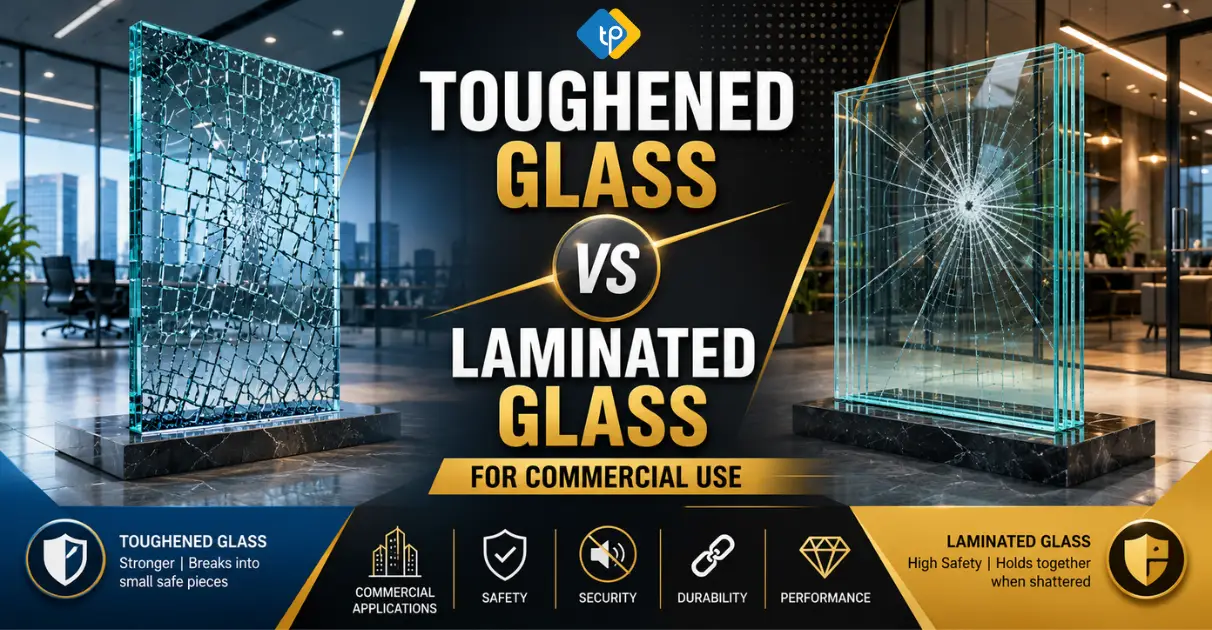
Toughened Glass VS Laminated Glass For Commercial Use
TOUGHENED GLASS VS LAMINATED GLASS FOR COMMERCIAL USE: CHOOSING WHAT’S RIGHT FOR YOUR BUSINESS
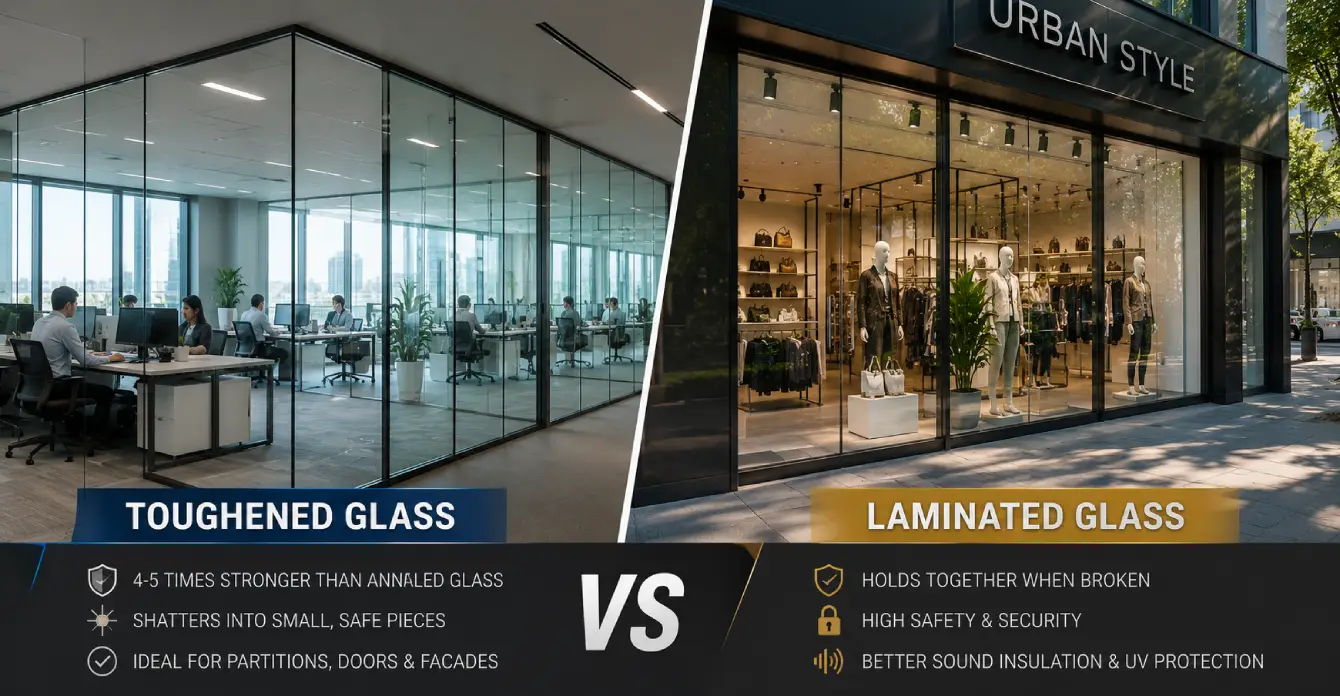
Which Glass Should You Choose For Your Commercial Space?
You’re planning a new commercial space or maybe renovating an existing one. Someone mentions glass – should it be toughened glass vs laminated glass? You nod like you understand, but honestly, they sound like the same thing. They’re not. We’ve walked into enough offices and retail spaces to know that people pick glass based on what their architect tells them or what costs less. Sometimes that’s right. Sometimes it’s completely wrong.
We work with both types all the time, and we’ve seen what happens when businesses make the right choice and what happens when they don’t. The difference is huge. We’re talking safety issues, security problems, modification headaches, and budget surprises. So let’s talk about this properly.
The thing about toughened glass vs laminated glass is that they solve different problems. Toughened glass makes something stronger. Laminated glass makes something safer. When you understand that difference then choosing becomes easier. We’ve learned this through years of installing both materials in every kind of commercial space you can think of.
Understanding What These Two Materials Actually Are
Let’s stop treating this like rocket science. Toughened glass vs laminated glass is not complicated once you understand what each one does.
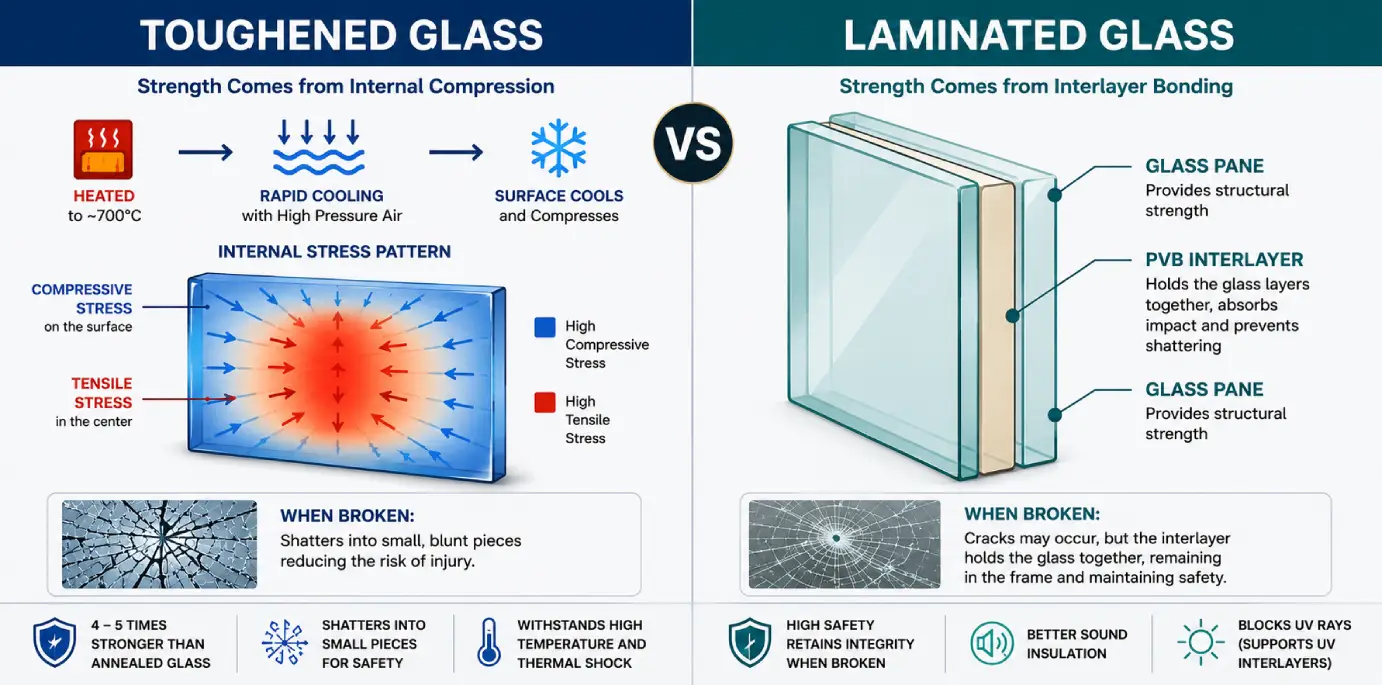
Toughened glass – sometimes people call it tempered glass – goes through a specific heating process. They take regular glass, heat it to really high temperatures, then cool it super fast. This creates stress inside the glass that makes it incredibly strong. We’ve watched this happen at manufacturing facilities, and it’s honestly impressive. The rapid cooling creates this permanent internal tension that’s responsible for all the strength.
Laminated glass works totally differently. You take two pieces of glass and stick them together with a middle layer. That middle layer is usually made from something like PVB or polyurethane – basically a really strong adhesive material. When the glass breaks, that middle layer holds everything together. It’s kind of like a safety windshield in a car, which is actually laminated glass.
The way toughened glass vs laminated glass behaves is completely different. Toughened glass either holds or breaks – there’s no in-between. When it does break, it turns into thousands of tiny pellets. Laminated glass cracks but stays stuck together. Picture a cracked phone screen – the glass is broken but it is still one piece. That’s basically what laminated glass does.
The Real Reason People Get Confused About These Materials
Here’s why so many business owners struggle with toughened glass vs laminated glass – they’re not told the actual differences. Someone says “we can use either one” and people think they’re basically the same. They’re not even close.
We had a client once who needed a glass partition in their office. They went with toughened glass because it was cheaper. Six months later, they wanted to move some walls around. Guess what? You can’t cut toughened glass after it’s been tempered. The entire thing would shatter. They had to order all new glasses. Cost them probably 5-6 times what they saved initially.
That’s the thing about toughened glass vs laminated glass – the cheaper option isn’t always smarter. We always ask our clients what they think they’ll need in the future. Will you modify this? Do you need security? Do you need soundproofing? Is the appearance important? These questions change everything about which material makes sense.
WHAT IS TOUGHENED GLASS AND HOW DOES IT’S WORKING
The Manufacturing Process Explained Simply
When we explain toughened glass vs laminated glass to people, we start with how the glass gets made because that is where all the differences come from.
Toughened glass manufacturing is actually pretty straightforward. First, they take regular glass and clean it completely. Then it goes into a furnace where temperatures reach around 650 degrees Celsius. We’re talking about heat that would melt most materials. The glass does not melt – it gets soft and flexible at this temperature, which is the whole point.
Here’s the critical part – they pull the glass out of that furnace and cool it down really fast. We mean really fast. Cold air blasts hit all sides at the same time. This rapid cooling is what creates the magic. The outside surface cools immediately, but the inside is still trying to cool down. This creates permanent internal stress throughout the entire piece.
That stress is why toughened glass vs laminated glass is such a different animal. The stress makes toughened glass about four to five times stronger than regular glass. It can handle impacts that would destroy standard glass.
What Toughened Glass Does Well
When we install toughened glass vs laminated glass in commercial spaces, toughened glass excels in specific situations:
- Handles direct impacts without breaking easily – we’ve seen office chairs rolled into glass partitions hundreds of times with minimal damage
- Resists temperature changes – perfect for areas with heating and cooling or outdoor exposure
- Creates a sleek, modern appearance – let’s be honest, it looks good
- Shatters safely into small granules instead of sharp shards – this is huge for safety
- Provides excellent transparency – nothing blocks the view
- Works in high-traffic areas where impact is expected
We did an office renovation once where toughened glass partitions replaced traditional walls. The space felt completely open and modern. Natural light flowed everywhere. People loved it. That’s the aesthetic advantage of toughened glass vs laminated glass.
The Major Problem With Toughened Glass
Here’s the catch with toughened glass vs laminated glass – once it’s tempered, it’s locked in. You cannot modify it. You cannot cut it, drill it, or change it in any way. The second you try to cut it, that internal stress releases and the glass basically explodes.
We had a contractor who didn’t realize this. They ordered toughened glass panels and then the measurements changed slightly. They thought they could just trim the edges. They couldn’t. The entire panel cracked when they tried. Cost them a lot of monies to replace it.
This is why precision matters so much with toughened glass vs laminated glass. Every measurement has to be perfect, before manufacturing. There’s no fixing it later. We always tell clients – if you think you might need changes, toughened glass probably isn’t your material.
Where We Actually Install Toughened Glass
When we recommend toughened glass vs laminated glass, toughened glass gets chosen for:
- Interior office partitions and glass walls – these are the most common. They look modern, handle daily bumps, and create open working spaces.
- Glass doors in commercial buildings – the strength handles repeated opening and closing from hundreds of people daily. We’ve installed these in corporate offices and they hold up beautifully.
- Balustrades and safety barriers – when people lean on them, toughened glass can take that weight and pressure. Safety railings on balconies and mezzanines use toughened glass regularly.
- Exterior cladding on buildings – the thermal resistance matters here. Buildings with lots of sun exposure benefit from toughened glass’s ability to handle temperature swings.
- Shower enclosures in commercial facilities – the heat and moisture don’t degrade toughened glass the way they do regular glass.
We completed a project where toughened glass completely transformed a corporate office. The old solid walls came down and toughened glass partitions wants up. Suddenly the space felt huge, light, and modern. That transformation only works with toughened glass vs laminated glass because of the aesthetic clarity.

WHAT IS LAMINATED GLASS AND WHY IT IS DIFFERENT
How Laminated Glass Actually Works
When we talk about toughened glass vs laminated glass, understanding how lamination works is essential because it’s fundamentally different from tempering.
Laminated glass is basically two panes of glass bonded together with a middle layer. That middle layer is the crucial part – it’s usually PVB (polyvinyl butyral) or polyurethane, both of which are incredibly strong adhesives. The glass panes get stuck to this interlayer using heat and pressure. When done properly, the bond is permanent and incredibly strong.
The magic of toughened glass vs laminated glass comes down to what happens when things break. When laminated glass gets hit hard enough to crack, the cracks spread through the glass, but the interlayer holds everything together. Picture a car windshield after an accident – completely cracked but still in one piece. That’s exactly what laminated glass does.
We’ve tested this ourselves on job sites. You can hit laminated glass hard, and when it breaks, it’s still one solid unit. Nothing falls out. Nothing becomes a weapon. That’s fundamentally different from toughened glass vs laminated glass where the glass turns to granules.
The Safety Advantage of Laminated Glass
This is where toughened glass vs laminated glass becomes about protecting people. The safety benefits of laminated glass are serious.
First, there’s no falling glass. If a window breaks on the 10th floor and it’s toughened glass, you might get pebbles falling. If it’s laminated glass, nothing falls. That’s a big difference for people on the streets below. We worked on a high-rise where this mattered – the structural engineer specifically required laminated glass because of fall hazards.
Second, security improves dramatically. If someone tries to break into a storefront with laminated glass, they’re fighting a material that won’t give up. It takes forever to break through. We’ve had retail clients tell us that laminated glass has literally stopped break-ins. Criminals see that it won’t break easily and they move on to easier targets.
Third, glass fragments never become a threat. In regular glass breakage, you get those dangerous shards that cut people. Toughened glass granules are better than that, but laminated glass doesn’t have this problem at all. It just stays together.
Extra Benefits That Make Laminated Glass Special
Beyond safety, toughened glass vs laminated glass shows other advantages for laminated:
UV Protection: The interlayer blocks ultraviolet light. We put laminated glass in a retail store once, and the owners noticed that display items weren’t fading as fast. Furniture and merchandise last longer when UV is blocked.
Sound Reduction: That interlayer absorbs sound vibrations. A conference room we worked on was right next to a busy road. Changing to laminated glass made meetings actually quiet. People could hear each other. It’s probably 30-40% noise reduction, which is real improvement.
Privacy Benefits: When laminated glass cracks, the pattern stays visible. It’s harder to see through without looking closely. Some clients appreciate the subtle privacy this creates.
The Biggest Advantage Over Toughened Glass
Here’s where toughened glass vs laminated glass really differs in practical terms – you can modify laminated glass after it’s made.
We can cut laminated glass. We can drill holes in it. We can customize it to fit your exact needs even after you order it. This flexibility has saved us countless times when projects need an adjustment. A client realizes they need a hole for a cable, or measurements change slightly – with laminated glass, we handle it. With toughened glass, you’re ordering new panels.
We had an office renovation where the client initially ordered toughened glass but then wanted to add cable management holes. Couldn’t do it. They would have lost everything. We switched their order to laminated glass and everything worked out fine. That one decision saved them major money and headaches.
Where We Install Laminated Glass
When we recommend toughened glass vs laminated glass, laminated glass gets chosen for:
- Ground-floor storefronts – retail shops, banks, restaurants. Security and safety matter at street level.
- Skylights and overhead glazing – nothing falls if it breaks. Safety for everyone below.
- High-rise building facades – the drop hazard requires materials that hold together.
- Conference rooms needing soundproofing – especially near busy roads or airports.
- Security-sensitive areas – banks, government buildings, facilities needing protection.
- Windows in extreme weather areas – high-wind regions, earthquake zones, hail-prone areas.
We did a retail shopping arcade with laminated glass skylights. The peace of mind for everyone inside knowing nothing would crash through was genuinely valuable. That is the difference toughened glass vs laminated glass makes in real life.
DIRECT COMPARISON – TOUGHENED GLASS VS LAMINATED GLASS
How They Break – The Critical Difference
Let’s get specific about toughened glass vs laminated glass because understanding breakage patterns is crucial.
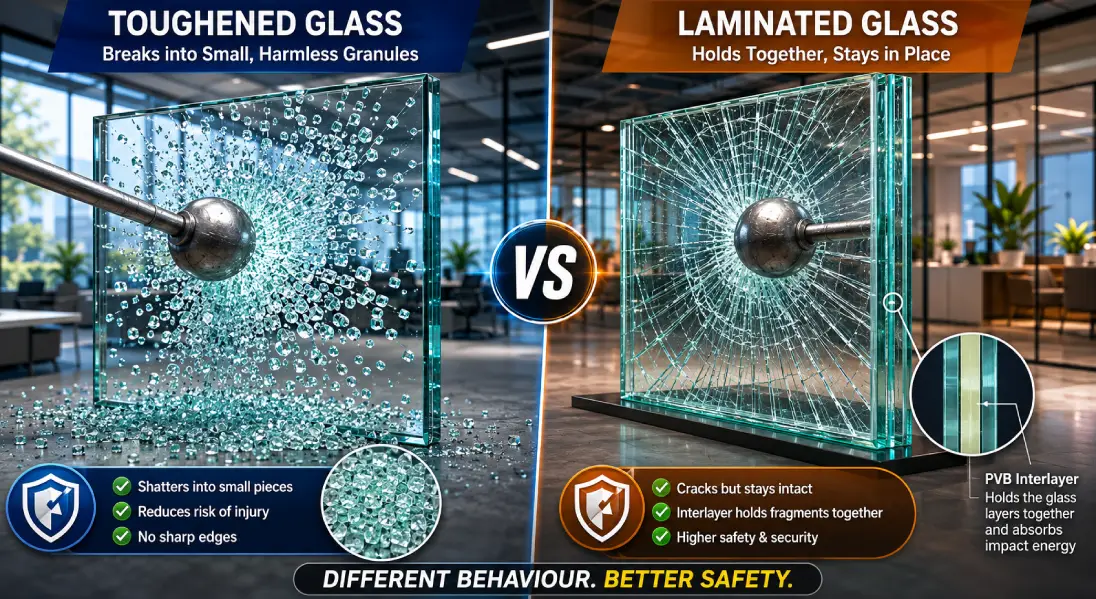
We once had a heavy object hit a toughened glass partition. The entire panel turned into tiny granules – like sand on the floor. You could sweep it up. No big shards, no cutting hazards. It was honestly safe.
We had another situation where something hit laminated glass in a storefront. Complete spiderweb of cracks across the entire panel. But here’s the thing – the glass didn’t come apart. It stayed as one piece held together by that the middle interlayer. You could see the cracks clearly, but the structural integrity remained intact.
That’s toughened glass vs laminated glass in reality. Toughened goes from perfect to granules instantly. Laminated goes from perfect to cracked but holding. Different problems, different solutions.
Comparison Table: Feature-by-Feature Breakdown
| Feature | Toughened Glass | Laminated Glass |
|---|---|---|
| Impact Resistance | Extremely high – handles direct hits | High – some flex before breaking |
| Post-Break Safety | Harmless granules | Held together by interlayer |
| Thermal Resistance | Superior | Good – interlayer degrades with extreme heat |
| Sound Insulation | Minimal – single layer advantage | 30–40% noise reduction |
| UV Protection | Minimal | Blocked by interlayer |
| Security Level | Breaks too easily for serious security | Excellent – hard to break through |
| Modification After Manufacturing | Impossible – shatters | Possible – can cut and drill |
| Modern Appearance | Clean, sleek look | Clean look, slightly visible interlayer |
| Cost | Lower per square meter | Higher per square meter |
| Maintenance | Simple cleaning, avoid thermal shock | Simple cleaning, monitor cracks |
| Lifespan | 30+ years, technically permanent | 30–40+ years depending on interlayer |
| Customization Flexibility | None after manufacturing | High after manufacturing |
Strength Comparison – Not As Simple As It Sounds
When people ask which is stronger, toughened glass vs laminated glass, the answer isn’t straightforward. They’re strong in different ways.
Toughened glass is stronger at resisting breaking in the first place. It can be handle impacts that would shatter regular glass. But once you exceed its limit, it completely fails. There’s no middle ground.
Laminated glass is strong in a different ways. It bends a bit under pressure before breaking. When it does break, it stays functionally. The structure remains intact even though the glass is damaged.
We always explain it like this – toughened glass is like a rock. Laminated glass is like a safety windshield. The rock won not dent easily, but when it finally breaks, it explodes. The windshield will crack, but it holds together and you’re still protected.
For toughened glass vs laminated glass, the choice depends on what kind of strength you actually need.
Thermal Performance – Where Toughened Glass Wins
Temperature changes matter more than people realize. Toughened glass handles thermal stress beautifully. External installations with sun exposure work well because toughened glass vs laminated glass sees toughened excel at temperature management.
We installed toughened glass on an exterior wall that got intense afternoon sun light. It handled temperature swings that would have caused problems elsewhere. That’s the thermal advantage of toughened glass vs laminated glass.
Laminated glass can handle normal temperature changes, but the interlayer can eventually degrade if exposed to extreme heat consistently. We’ve seen older laminated glass installations in hot climates where the interlayer weakened slightly over decades.
Security Comparison – Laminated Wins Decisively
When security matters, toughened glass vs laminated glass isn’t really a contest. Laminated glass wins.
Someone trying to break into a storefront with toughened glass might succeed quickly. The glass breaks into granules and they are through. Laminated glass is a nightmare for them. It takes forever to break through. We’ve had clients tell us actual burglars have given up on laminated glass storefronts because it was too difficult.
For retail security, banks, high-value businesses, and sensitive facilities, toughened glass vs laminated glass means laminated is the only sensible choice.
ACTUAL INSTALLATIONS – WHERE EACH WORKS BEST
Toughened Glass Projects We’ve Done
When we recommend toughened glass vs laminated glass for toughened applications, we’ve got plenty of real examples.
We completed a corporate office renovation where toughened glass partitions replaced walls throughout the entire building. The space transformation was incredible. Natural light flowed everywhere. The open feel increased collaboration. That project showed exactly why toughened glass vs laminated glass sometimes means toughened is the right answer. The aesthetic clarity and modern look are unbeatable.
We have installed toughened glass in office doors at multiple corporate headquarters. These doors handle hundreds of people daily opening and closing them of all. The strength is essential. That’s where toughened glass vs laminated glass favors toughened – high-traffic areas with constant impact.
Another project involved glass balustrades on a parking structure. People lean on these, impact them, test their strength. Toughened glass was perfect because it handles that punishment while looking modern and sleek.
We’ve done exterior cladding projects where toughened glass was essential because of thermal exposure. A building that got direct sun in summer and cold winters needed material that could handle those temperature swings without cracking.
Laminated Glass Projects We’ve Done
When toughened glass vs laminated glass means recommending laminated, we’ve got equally strong examples.
We installed laminated glass in a high-rise building’s upper-floor windows. The structural engineer required it because of fall hazards if glass broke. Knowing that laminated glass would hold together if somehow damaged gave everyone peace of mind.
A retail shopping arcade got laminated glass skylights. The clients wanted to ensure that if glass ever failed overhead, nothing would fall on shoppers below. That security let them concentrate on their business instead of worrying about glass failures.
We replaced storefront windows at a bank with laminated glass. Security was the primary concern, and the difficulty of breaking through laminated glass was a genuine deterrent. Compare that to toughened glass vs laminated glass where toughened would break too easily for security purposes.
A medical facility requested laminated glass for conference rooms because they needed soundproofing for sensitive discussions. The interlayer in toughened glass vs laminated glass provided exactly the noise reduction they needed.
Mixed Projects – Using Both
Sometimes toughened glass vs laminated glass means we use both in the same project.
We worked on a modern office building that used toughened glass for interior partitions – they wanted that open, light, modern aesthetic. The exterior facade, though, used laminated glass because of safety and security requirements.
That combination made sense because each material was doing what it does best. Toughened glass vs laminated glass isn’t always an either-or decision.
HOW LONG DO THESE MATERIALS ACTUALLY LAST
Toughened Glass Lifespan
People ask us all the time how long toughened glass vs laminated glass actually lasts. With toughened glass, the answer is pretty straightforward.
When properly installed, toughened glass lasts forever under normal conditions. The tempering process creates permanent internal stress that doesn’t degrade. We’ve inspected 20-year-old installations that perform exactly as they did day one. The material itself doesn’t age or weaken.
The real issue with toughened glass vs laminated glass and toughened longevity comes from environmental factors. Extreme temperature cycling can eventually cause problems. We had one exterior installation where cold winters and hot summers created constant stress. Eventually, spontaneous cracking occurred.
We’ve learned that toughened glass vs laminated glass means toughened needs protection from thermal shock. Regular extreme temperature changes shorten its lifespan.
Under normal conditions, expect 30+ years minimum from toughened glass. In ideal conditions with stable temperatures, it lasts essentially indefinitely. The real limitation is usually the surrounding building components – frames rust, seals fail, buildings shift. The glass outlasts these.
Laminated Glass Lifespan
Toughened glass vs laminated glass shows different longevity patterns for laminated glass. The glass itself is permanent, but the interlayer eventually ages.
Quality PVB interlayers last 30-40+ years easily. We’ve inspected 25-year-old laminated glass installations where the interlayer remains solid and functional. The adhesion between glass and interlayer stays strong over normal timeframes.
The catch with toughened glass vs laminated glass is that extreme heat accelerates interlayer degradation. We’ve seen installations in extremely hot climates where the interlayer weakened slightly after 30-35 years. Not failed, just weakened.
Here’s the thing though – even weakened laminated glass continues doing its job. The safety benefit of fragments holding together persists even if the bond weakens. We’ve inspected 40-year-old laminated glass and even aged, it’s still functional.
For practical purposes, both toughened glass vs laminated glass materials provide 30+ years of reliable service. Environmental conditions affect their longevity, but both significantly outlast most building components.
Real Situation We Encountered
We had a retail storefront that installed laminated glass 35 years ago. The interlayer showed its age – slight yellowing, minor weakening of adhesion. But the laminated glass was still functional, still providing security, still protecting people if it broke. The client could have replaced it for aesthetic reasons, but functionally, it was still doing its job.
That’s what toughened glass vs laminated glass means for lifespan – both last decades. Toughened is theoretically permanent, but fragile to temperature changes. Laminated lasts as long but depends on interlayer quality. Choose based on your needs, not lifespan, because both will outlast most other building components.
SAFETY STANDARDS AND BUILDING RULES
Why Building Codes Matter
We deal with building inspectors regularly, and they take glass selection seriously. Toughened glass vs laminated glass isn’t left to personal preference – there are actual rules.
Most commercial projects require compliance with specific safety standards. These vary by location and building type, but they exist because someone got hurt in the past. Building codes are written in blood, basically. Someone made a wrong choice and people got hurt, so now there are rules.
We always tell clients that toughened glass vs laminated glass requirements depend on what the building is and where it is. A ground-floor retail space has different requirements than an interior office partition. A high-rise facade has different requirements than a boardroom.
Standards and Certifications
Commercial glass installations generally need to meet standards like:
- IS 12040 – Safety requirements for toughened glass
- IS 12600 – Safety requirements for laminated glass
- IS 3934 – Float glass specifications
- Local building codes – Vary by region
- Occupational safety standards – Workplace protection requirements
When we submit plans with glass specifications, building officials review them against these standards. They’re checking whether toughened glass vs laminated glass choice is appropriate for the specific application.
We’ve had building inspectors reject toughened glass for applications where safety codes required fragments to remain together – meaning laminated was necessary. We’ve also had them approve either material where application-specific risks were minimal.
Real Safety Issues
We had a situation where toughened glass in an exterior location spontaneously cracked from thermal stress. Nobody got hurt because toughened glass granules are safe, but that incident showed why environmental assessment matters for toughened glass vs laminated glass selection.
We’ve also seen security situations where toughened glass would have been a disaster – the building was broken into because glass broke too easily. With laminated glass replacing it, break-ins stopped. That’s a real safety and security issue affecting toughened glass vs laminated glass choice.
For official safety guidance, check with your local municipal corporation or building authority. They’ll tell you what toughened glass vs laminated glass rules apply to your specific situation.
COST REALITY – WHAT YOU’LL ACTUALLY SPEND
Material Costs for Each Type
When it comes to toughened glass vs laminated glass, cost differences are real but context matters.
Toughened glass typically costs less per square meter – approximately 3,000-5,000 rupees depending on thickness and quality. Laminated glass costs more – approximately 5,000-8,000 rupees per square meter.
But here’s where toughened glass vs laminated glass cost analysis gets complicated. The cheaper upfront cost for toughened glass doesn’t mean cheaper total project cost.
Hidden Costs That Matter
We had a client choose toughened glass to save money. Three months later, they wanted to reorganize their space. The toughened glass couldn’t be modified – they ordered new panels. Suddenly their savings disappeared and the project went 30% over budget. That’s what toughened glass and laminated glass means for hidden costs.
Another client chose laminated glass. When measurements turned out slightly different after installation, we made adjustments. Project stayed on budget. That flexibility of toughened glass vs laminated glass where laminated can be modified sometimes saves money overall.
Installation costs are similar for both materials, so the real cost difference comes from what happens after installation and whether modifications are needed.
Total Project Cost Thinking
We always tell clients – don’t just compare per-square-meter costs. Think about your whole project. Will you need changes later? Do you need security? How important is appearance? These factors change whether toughened glass vs laminated glass means toughened or laminated is actually cheaper for your specific situation.
For a typical office renovation, toughened glass vs laminated glass might mean 3,000-5,000 rupees per square meter for toughened versus 5,000-8,000 rupees for laminated. But if the toughened glass can’t be modified and you need changes, suddenly you’re buying twice.
Get quotes for both materials. Compare total project costs, not just material costs. That’s the smart way to approach toughened glass vs laminated glass financially.
MAINTENANCE AND CARE
Cleaning Both Types
Maintaining toughened glass vs laminated glass is pretty similar for day-to-day cleaning.
Both respond well to standard glass cleaners. Use a soft cloth, spray cleaner, wipe clean. That’s it. For both materials, the key is being gentle and not forcing anything.
With toughened glass vs laminated glass, the difference comes in what you avoid.
Caring for Toughened Glass
With toughened glass, the critical thing to avoid is thermal shock. Never spray ice-cold water on hot glass. We had a building manager cleaning exterior toughened glass with a cold water hose on a hot sunny day. The glass cracked from thermal stress. Lesson learned.
Regular inspection is good practice. Check toughened glass vs laminated glass toughened installations annually for any signs of trouble. Catching issues early prevents failures.
We recommend:
- Annual professional inspection
- Avoid rapid temperature changes
- Don’t clean hot glass with cold water
- Monitor for spontaneous cracks from thermal stress
- Clean using gentle methods
Caring for Laminated Glass
Laminated glass is simpler in some ways. The interlayer requires no special care. Just keep it clean.
If laminated glass does crack, we recommend prompt repair. Moisture can work through cracks over time and weaken the interlayer bond. Address cracks relatively quickly rather than leaving them indefinitely.
We recommend:
- Clean regularly with standard glass cleaner
- Monitor cracks and repair them promptly
- Avoid pressure on damaged areas
- Annual inspection for interlayer integrity
- Gentle cleaning methods
Prevention Is Always Better
For both toughened glass vs laminated glass, prevention beats treatment every time. Proper installation, thoughtful placement, and avoiding extreme conditions keep your glass looking and performing well for years.
THE ULTIMATE SOLUTION – TOUGHENED LAMINATED GLASS
Combining Both Technologies
Here’s something we recommend more and more: why choose between toughened glass vs laminated glass when you can have both? Toughened laminated glass combines the best of each technology.
You take toughened glass panels and laminate them – bond a second pane with that interlayer. Now you’ve got:
- The exceptional strength of toughened glass
- The safety and security benefits of laminated glass
- The thermal resistance of toughened glass
- The sound reduction of laminated glass
- The security properties of laminated glass
- Ultimate protection in one product
When toughened glass vs laminated glasses means both matter equally, toughened laminated glass is the answer.
When Toughened Laminated Glass Makes Sense
This premium option suits:
- High-security buildings – Maximum protection for sensitive locations
- Premium office spaces – Strength and aesthetic clarity plus soundproofing
- Bank and financial facilities – Security and strength combined
- Executive boardrooms – Privacy, sound insulation, and modern appearance
- Government buildings – Protection requirements for sensitive facilities
- Medical and research facilities – Security and sound control
- High-end retail – Security and appearance
The Cost Factor
Toughened laminated glass costs more – you’re basically paying for two advanced technologies. But for important projects, this investment delivers unbeatable performance and peace of mind.
When toughened glass vs laminated glass becomes toughened laminated glass, you’re not compromising on either strength or safety. You’re getting everything.
For guidance on whether this solution suits your project, reach out to TwinPro Ventures for consultation. We can assess your needs and recommend whether toughened glass vs laminated glass or toughened laminated glass makes most sense visit our site TwinPro ventures
FREQUENTLY ASKED QUESTIONS
Q1: Can I cut or drill toughened glass after manufacturing?
This is the most important thing to understand about toughened glass vs laminated glass. The answer is absolutely no.
Once glass is tempered, the internal stress is permanent. The second you try to cut or drill it, that stress releases and the entire piece breaks explosively. You cannot modify toughened glass under any circumstances after tempering.
This is why toughened glass vs laminated glass measurement precision matters so much with toughened. Every dimension must be exactly right during manufacturing. If you need changes later, you order new glass. That’s expensive.
If you think your project might need post-installation modifications, laminated glass is your better choice because it can be cut and drilled after manufacturing.
Q2: Is toughened glass actually stronger than laminated glass?
This depends on what you mean by “stronger” when asking about toughened glass vs laminated glass.
Toughened glass is stronger at resisting breaking in the first place. It handles direct impacts better. But once you exceed its limits, it completely fails.
Laminated glass is strong in terms of maintaining structural integrity after breaking. It can flex slightly under pressure. When it breaks, it stays functional.
Think of toughened glass vs laminated glass like this – toughened is like a rock (doesn’t dent but shatters completely), laminated is like a windshield (flexes then cracks but holds together).
Choose based on what kind of strength your application needs. For impact resistance, toughened wins. For post-break functionality, laminated wins.
Q3: Why does toughened glass sometimes spontaneously crack?
This happens because of thermal stress, and it’s one of the real limitations of toughened glass vs laminated glass.
Toughened glass has permanent internal stress. When you subject it to rapid temperature changes, that stress can exceed limits and cause failure. We’ve seen it happen when cold water hits hot glass, or when cold winter weather follows hot summer sun.
Laminated glass doesn’t have this problem because it lacks internal stress. Understanding thermal limitations of toughened glass vs laminated glass helps prevent these failures.
Proper installation and environmental planning prevent most thermal stress issues with toughened glass.
Q4: How much noise actually reduces with laminated glass?
When toughened glass vs laminated glass means considering soundproofing, laminated glass delivers real improvement.
The interlayer absorbs sound vibrations. Typical noise reduction ranges around 30-40% compared to standard single pane glass. Thicker interlayers provide more sound reduction.
We put laminated glass in a conference room near a busy road, and people immediately noticed the difference. Meetings were quieter. Conversations were clearer. It’s not perfect soundproofing, but the improvement is genuine and noticeable.
For soundproofing applications, toughened glass and laminated glasses strongly favors laminated.
Q5: How many years will these materials actually last?
When deciding between toughened glass vs laminated glass, lifespan is worth understanding.
Both typically last 30+ years under normal condition. Toughened glass can theoretically last indefinitely if environmental conditions remain stable and thermal stress is minimal. Laminated glass lasts as long, though the interlayer eventually age after 40+ years.
The real limitation for both materials isn’t the glass – it’s the surrounding building components. Frames rust, seals fail, buildings shift. The glass usually outlasts these other elements.
Environmental conditions affect longevity more than material differences. Both toughened glass vs laminated glass options will serve commercial buildings reliably for decades.
MAKING YOUR ACTUAL DECISION
Understanding Your Real Needs
When you’re choosing between toughened glass vs laminated glass, stop thinking about material specs and start thinking about actual needs.
Will you modify this glass after installation? That’s the first question. If yes, laminated is your answer. With toughened glass, modifications mean ordering new panel.
Do you need security? If yes, laminated glass is significantly better. Toughened breaks too easily for serious security.
Do you need soundproofing? Laminated glass provides real noise reduction. Toughened glass offers minimal sound control.
Is this interior or exterior? Exterior applications often favor toughened glass for thermal resistance. Interior is more flexible.
How important is aesthetic appearance? Both look good, but toughened glass has slightly cleaner appearance because there’s no visible interlayer.
What’s your budget? Toughened glass costs less per square meter, but total project costs depend on your other needs.
Is extreme temperature exposure possible? Toughened glass needs protections from thermal shock. Laminated handles extremes better.
Questions That Really Matter for Toughened Glass vs Laminated Glass Decision
Ask yourself:
- Will I definitely never need modifications? Only choose toughened if answer is yes.
- Is security important? Laminated is mandatory for security.
- Is soundproofing needed? Laminated for noise control.
- Will temperature conditions be extreme? Laminated handles extremes better.
- What’s the lifespan I’m planning? Both last 30+ years, so this doesn’t differentiate.
- Is modern aesthetic critical? Toughened has slight edge here.
- What does my building code require? Check locally – requirements vary.
Your answers to these questions guide whether toughened glass and laminated glass means toughened or laminated for your situation.
MOVING FORWARD WITH YOUR PROJECT
Getting Professional Advice
This is crucial – toughened glass and laminated glasses decisions shouldn’t be made without professional assessment of your specific situation.
Different buildings need different solutions. What works for an office tower is wrong for a retail shops. What’s right for a ground-floor storefront might be overkill for an interior partition.
We’ve spent years learning which material works where, and honestly, the decision gets complicated when you factor in local building codes, environmental conditions, security needs, and budget constraints.
If you want to discuss your specific project situation, we’re here to help. Reach out to TwinPro Ventures for a proper consultation about your commercial needs visit our site Twinpro Ventures
We’ll assess your situation honestly and tell you whether toughened glass and laminated glasses means toughened is right, laminated is right, or maybe even toughened laminated is what you actually need.
Understanding Building Compliance
Building regulations vary by location, so you need to check with your local authority about what toughened glass vs laminated glass rules actually apply.
Contact your local municipal corporation or building control authority. They’ll tell you what’s required for your building type and location.
For official safety standards information, check the Bureau of Indian Standards (BIS) website for glass safety requirements at Bureau of Indian Standards
Don’t assume that something works elsewhere – your specific location has specific rules about toughened glass and laminated glasses requirements.
RESOURCES FOR FURTHER INFORMATION
More Reading About Toughened Glass vs Laminated Glass
We’ve covered substantial ground here. For deeper exploration of specific topics related to toughened glass vs laminated glasses:
For commercial glass applications and case studies please visit Twin Proven Ventures’ commercial glass solutions
For building safety and compliance information: Check the Bureau of Indian Standards (BIS)
For local building requirements: Contact your municipal corporation’s building control department
For structural engineering considerations: Consult with your project’s structural engineer about specific requirements for your situations