


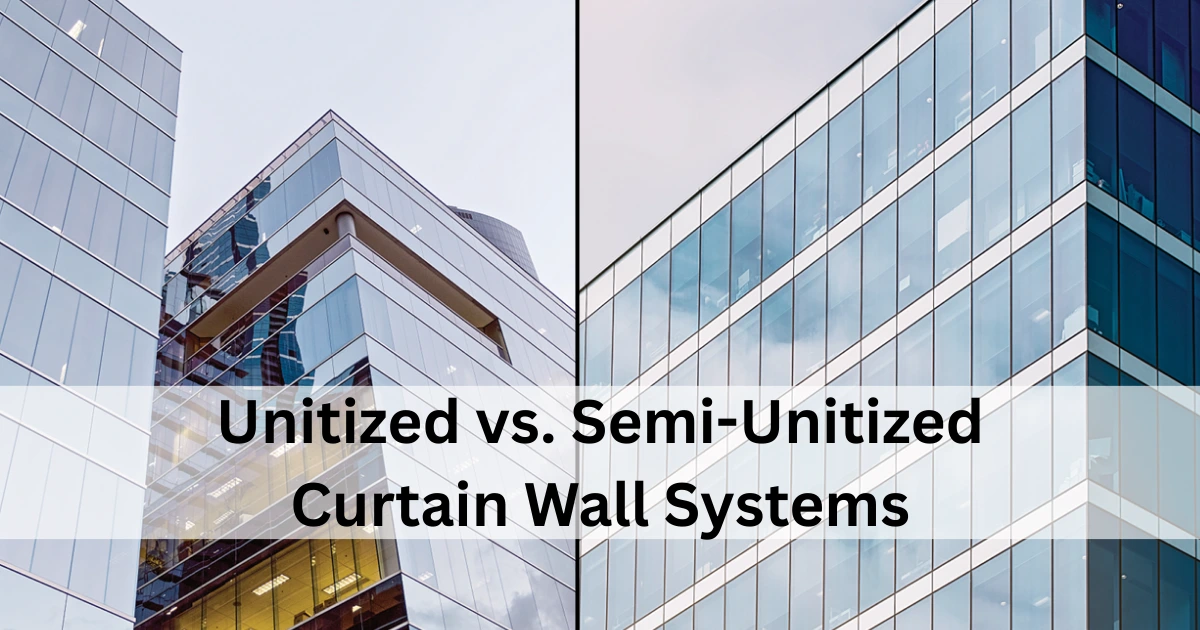
Unitized vs. Semi-Unitized Curtain Wall Systems: Technical Comparison for Commercial Facades
The selection of an appropriate curtain wall system significantly influences facade performance, installation efficiency, structural coordination and long-term building durability. Among the most widely adopted systems in contemporary commercial construction are the unitized curtain wall system and the semi-unitized curtain wall system. Although both systems achieve similar architectural outcomes, their engineering principles, fabrication processes and site execution methodologies differ substantially.
This article presents a technical comparison of unitized and semi-unitized facade systems, outlining their structural behavior, installation strategies, performance parameters and suitability across project typologies.
Curtain Wall Systems
Curtain wall systems are non-load-bearing exterior envelopes designed to resist wind loads, control air and water infiltration, accommodate thermal expansion, and provide aesthetic uniformity. Modern facade systems must satisfy structural, thermal, acoustic, and fire performance requirements while enabling constructability within project timelines.
The differentiation between unitized and semi-unitized systems lies primarily in the degree of factory prefabrication versus on-site assembly.
Unitized Curtain Wall System
System configuration
A unitized curtain wall system consists of large prefabricated modules assembled entirely in a factory-controlled environment. Each unit typically includes:
- Aluminum framing (mullions and transoms)
- Glazing panels (often double or insulated glazing units)
- Gaskets and sealants
- Thermal breaks
- Anchoring brackets
These pre-engineered panels are transported to the site and installed floor-by-floor using lifting equipment.
Installation Methodology
Installation involves anchoring prefabricated units directly to slab edges or structural members. Interlocking vertical and horizontal joints between units ensure structural continuity and weather sealing.
Minimal site assembly reduces dependency on scaffolding and extensive on-site glazing work.
Performance Characteristics
- High-quality control due to factory fabrication
- Enhanced air and water tightness
- Improved dimensional accuracy
- Faster installation for high-rise applications
- Superior accommodation of inter-story drift
Unitized systems are particularly effective for high-rise commercial towers where repetitive facade geometry and strict project schedules are critical.
Semi-Unitized Curtain Wall System
System Configuration
A semi-unitized system combines factory-fabricated components with on-site assembly. Typically:
- Vertical mullions are installed first and anchored to slab edges.
- Horizontal transoms are fixed subsequently.
- Glazing panels are installed after framing alignment.
Unlike fully unitized systems, part of the structural and sealing work occurs on-site.
Installation Methodology
The process requires:
- Sequential installation of vertical and horizontal members
- Field alignment adjustments
- On-site glazing and sealing
- Greater coordination among installation teams
Scaffolding or temporary platforms are often necessary for installation at height.
Performance Characteristics
- Lower initial fabrication cost
- Increased design flexibility
- Greater reliance on site workmanship
- Moderate installation timeline
Semi-unitized systems are generally suitable for low- to mid-rise commercial buildings where site access and labor availability are manageable.
Comparative Technical Analysis
| Parameter | Unitized System | Semi-Unitized System |
| Fabrication | Factory-assembled modules | Partial factory fabrication |
| Installation Speed | High | Moderate |
| Site Labor Dependency | Low | High |
| Quality control | Superior | Dependent on site execution |
| Structural Movement Accommodation | Excellent | Moderate |
| cost Structure | Higher upfront cost | Lower initial cost |
| Project Suitability | High-rise, repetitive geometry | Low to mid-rise, flexible designs |
Engineering Considerations in System Selection
System selection should not be based solely on initial cost. The following parameters must be evaluated during specification:
Wind Load and Structural Anchoring
High-rise structures require systems capable of accommodating lateral deflection and wind pressure without joint failure.
Inter-Story Drift
Unitized systems provide better performance under vertical movement conditions due to integrated joint design.
Water Management and Drainage
Pressure-equalized chambers, gasket integrity, and seal continuity determine long-term facade durability.
Thermal and Acoustic Performance
Proper integration of double glazing, thermal breaks, and insulation detailing influences energy efficiency and indoor comfort.
Installation Logistics
Project timelines, crane access, and site congestion must be considered when selecting installation methodology.
Application Strategy in Commercial Projects
In high-rise commercial developments, where speed, precision, and performance are paramount, unitized curtain wall systems provide measurable advantages in installation efficiency and envelope integrity.
Conversely, semi-unitized systems offer cost-effective solutions for projects with lower height, complex geometries, or phased execution requirements.
The decision must align with structural design intent, environmental exposure conditions, and lifecycle performance expectations.
Integrated Facade Engineering Approach
Effective facade implementation requires coordination between architects, structural engineers, facade consultants, and installation teams. Integrated facade solutions, including unitized systems, semi-unitized systems, structural glazing, and cladding assemblies, must be evaluated holistically during the design development stage.
At TwinPro Ventures, facade engineering solutions encompass unitized curtain walls, semi-unitized systems, structural glazing, spider glazing, AcP cladding, and performance-driven glazing assemblies designed for commercial and institutional applications. With operational presence in Coimbatore, Chennai, and Bangalore, the company supports project teams in delivering technically aligned facade systems from design consultation to execution.
Conclusion
Unitized and semi-unitized curtain wall systems are both technically viable facade solutions when applied under appropriate structural and project conditions. Their effectiveness depends on building height, wind load requirements, installation logistics, fabrication strategy, and long-term performance objectives.
The selection process must be driven by engineering evaluation rather than procurement convenience. A facade system is not merely an architectural expression; it is a performance-critical building envelope that influences durability, energy efficiency, structural behavior and lifecycle maintenance.
For detailed technical specifications, system configurations, and facade solution capabilities, including unitized and semi-unitized curtain wall systems, refer to the product and engineering resources available at the TwinPro website.
Comprehensive system information, project consultation support, and integrated facade solutions are outlined to assist architects, engineers, and developers in making performance-driven decisions.
FAQs
1. What is a unitized curtain wall system?
A unitized curtain wall system uses fully prefabricated facade panels assembled in factories and installed as modules on site.
2. What is a semi-unitized curtain wall system?
A semi-unitized curtain wall system combines factory-made components with on-site framing, glazing, and sealing.
3. Which curtain wall system installs faster?
Unitized curtain wall systems install faster because most fabrication and glazing work is completed in factories.
4. Are unitized curtain wall systems better for high-rise buildings?
Yes, unitized systems are preferred for high-rise buildings due to better structural movement handling and installation efficiency.
5. When should semi-unitized curtain wall systems be used?
Semi-unitized systems are commonly used in low- to mid-rise buildings where design flexibility and lower upfront cost are priorities.